
Plant Encyclopedia

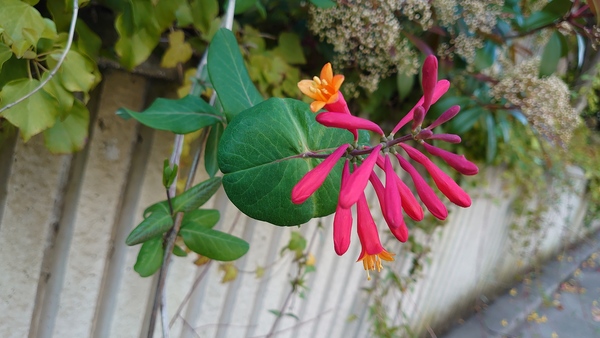
Lonicera sempervirens (coral honeysuckle, "Tsukinukinindo")
Japanese name: ツキヌキニンドウ (突抜忍冬、突貫忍冬)
Scientific name: Lonicera sempervirens
[Overview]
A semi-evergreen climbing shrub.
The vine twines to the right and branches well, growing to about 3 m, with the lower part becoming woody.
The leaves are simple and opposite, ovate to elliptic, 5–9 cm long and about 4 cm wide, with entire margins.
The one or two pairs of leaves just below the flowers are fused at the base, so the stem appears to pass through them.
The flowers are borne in several whorl-like tiers at the stem tips; they are tubular, 3–5 cm long, with the tip divided into 5 lobes.
The flower color is orange-yellow to red on the outside of the corolla and orange-yellow on the inside.
The fruit is a spherical berry that ripens red.
[History]
It was introduced to Japan in the first years of the Meiji era.
[Cultivation]
Propagate by cuttings.
It prefers sunny, well-drained, fertile soil.
For potted plants, water thoroughly when the soil surface dries; for plants in the ground, rainfall is sufficient unless sunny weather continues in summer and the soil becomes severely dry.
In early summer, apply slow-release fertilizer placed on the soil.
The vine does not twine well on its own, so tie it with string to train it.
There are no particular pests or diseases.
Details
Japanese: ツキヌキニンドウ(突抜忍冬、突貫忍冬)
Translated from our Japanese encyclopedia. If anything differs, the Japanese page is correct.