
Plant Encyclopedia

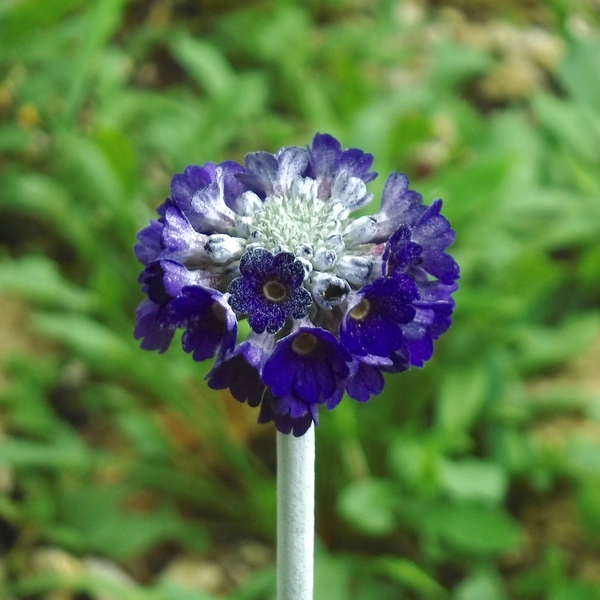
Primula capitata (round-headed Himalayan primrose)
Japanese name: プリムラ カピタタ
Scientific name: Primula capitata
[Overview]
In the wild, this perennial grows 15–30 cm tall in forests, grasslands, forest edges and along streams at elevations of 2,700–5,000 m.
It has no heat tolerance, so in warm regions of Japan it is treated as an annual.
The leaves are simple and basal, 12–15 cm long and about 2 cm wide, elliptic-oblanceolate to elliptic-spatulate, and the undersides are covered with white powder.
The leaf margins are toothed.
A spherical umbel at the tip of the flower stalk bears densely packed flowers.
The corolla is 5-lobed, and each lobe is shallowly 2-lobed at the tip.
The flowers are bluish purple with a yellow eye.
The flower stalk, calyx and outside of the corolla are covered with white powder.
The fruit is a capsule.
[Cultivation]
Propagate from seed or by division.
The seeds need light to germinate, so do not cover them with soil, and water from the bottom.
It prefers partial shade with good air circulation, and in cold regions it will also grow in full sun.
When planted in the ground, a spot under deciduous trees is suitable.
It prefers well-drained soil, so plant it in Kiryu sand, Kanuma soil or pumice mixed with sphagnum moss.
Soil for mountain and wild plants may also be used.
Take care not to let it dry out severely; for potted plants, in spring water thoroughly when the soil surface dries, and in summer water in the evening after the temperature has dropped, also sprinkling water around the pot so the plant stays cool through the night.
Even during dormancy, give water so that the soil does not dry out completely.
In addition to a basal fertilizer, place slow-release fertilizer on the soil in spring, and make sure no fertilizer remains in summer.
Leaving spent flowers can cause disease, so remove them promptly.
If you do not intend to collect seed, cut off the flower stalks once the flowers have almost finished blooming.
Pests and diseases include damping-off, botrytis, soft rot, gray mold, cutworms, slugs, nematodes and root mites.
Details
Japanese: プリムラ カピタタ
Translated from our Japanese encyclopedia. If anything differs, the Japanese page is correct.