
Plant Encyclopedia

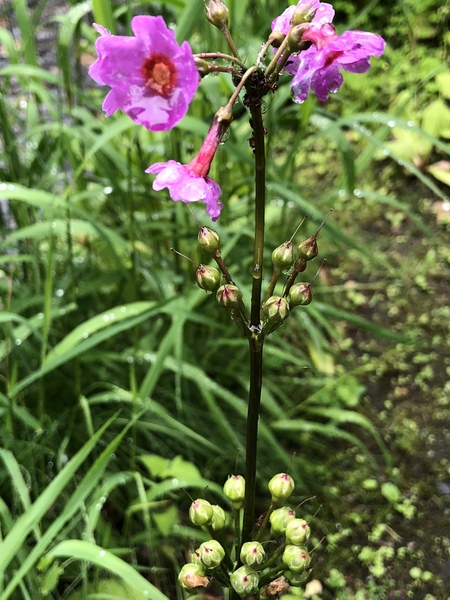
Primula japonica (Japanese primrose, "Kurinso")
Japanese name: クリンソウ (九輪草)
Scientific name: Primula japonica
[Overview]
A perennial 30–80 cm tall, found in wet ground in the mountains.
It sometimes grows in colonies.
It has a short underground stem.
The leaves are simple and basal, oblong, 15–40 cm long and 5–13 cm wide.
The leaf surface is much wrinkled.
The leaf margins have many low triangular teeth.
The leaf base gradually narrows into a petiole-like form.
At the tip of a flower stalk 30–80 cm tall, many flowers are borne in 2–5 whorled tiers.
The flower stalk is hairless.
The corolla is 2–2.5 cm across, 5-lobed, and reddish purple with a darker center.
The fruit is a spherical capsule 0.7 cm long, about the same length as the calyx.
[Cultivation]
Propagate from seed or by division.
It prefers well-drained, moisture-retentive soil and a cool, airy environment.
From autumn until flowering, give it full sun; in summer, a well-ventilated spot in partial shade is best so that it is not weakened by heat and dryness.
Take care not to let it dry out: during the growing season, water thoroughly as soon as the soil surface begins to dry, and take care that it does not dry out even during dormancy.
Apply a slow-release fertilizer rich in phosphate and potash as a base fertilizer, and give diluted liquid fertilizer once every 2 weeks to 1 month during the flowering period, making sure no fertilizer remains in summer.
If you do not want to collect seed, cut off the flowers together with their stalks once they finish, so the plant does not become exhausted.
Pests and diseases include armyworms, slugs and nematodes.
[Notes]
The Japanese name compares the way the flowers are borne to the kurin (the ring ornament) on the roof of a Buddhist pagoda.
Details
Japanese: クリンソウ(九輪草)
Translated from our Japanese encyclopedia. If anything differs, the Japanese page is correct.