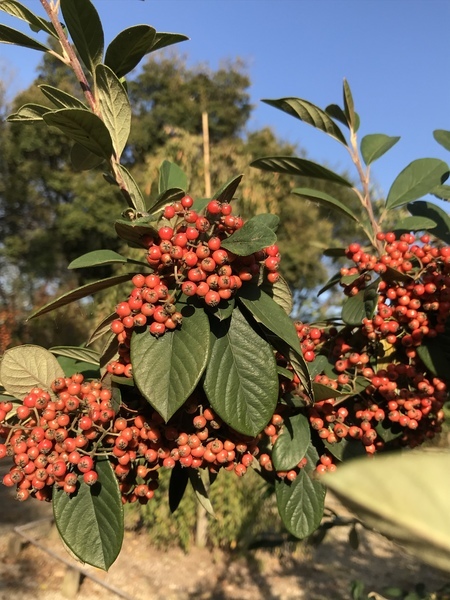
Japanese name: コトネアスター ラクテウス Scientific name:Cotoneaster lacteus
[Overview]
An evergreen shrub reaching 4 m tall.
Young branches are densely covered with short white hairs at first, but later become hairless.
The branches arch outward.
Leaves are simple and alternate, obovate to elliptic, about 6 cm long.
The upper surface of the leaf is dark green, and the underside is densely covered with white hairs.
The leaf margin is entire.
Corymbs bear many white 5-petaled flowers.
The fruit is a pome that ripens red and remains until winter.
[Cultivation]
Propagate from seed or cuttings.
Seed germination drops sharply once the seed dries, so remove the pulp and sow immediately, or store the seed so that it does not dry out.
It prefers sunny, well-drained, fertile sandy soil, but is not particular about soil type.
For potted plants, water thoroughly when the soil surface dries; for plants in the ground, rainfall is sufficient unless the soil becomes extremely dry.
Apply slow-release or organic fertilizer twice, in winter and after flowering.
In principle, grow it in its natural shape without pruning, but if you wish to prune, do so in February–March.
Pests and diseases include spider mites, which may appear in the high temperatures of summer.