EVERGREEN

Plant Encyclopedia

Cotoneaster salicifolius

Cotoneaster salicifolius (willow-leaved cotoneaster)

Japanese name: コトネアスター サリキフォリウス
Scientific name: Cotoneaster salicifolius

Cotoneaster salicifolius

[Overview]
An evergreen to semi-evergreen shrub growing to 5 m tall.
The branches grow long in an arching form.
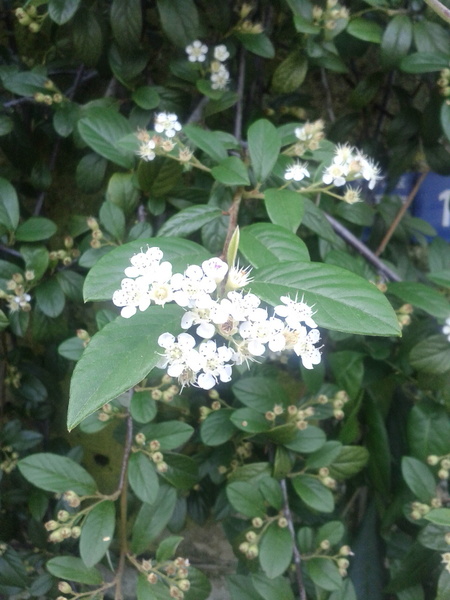
The leaves are simple and alternate, lanceolate, 5–10 cm long.
The upper surface of the leaf is dark green and wrinkled, and the underside bears white hairs.
The leaf margin is entire.
Corymbs bear many white 5-petaled flowers 5–6 mm across.
The fruit is a pome that ripens red and remains until winter.

[Cultivation]
Propagate from seed or by cuttings.
The germination rate of the seeds falls sharply when they dry out, so remove the pulp and sow immediately, or store them so that they do not dry out.
It prefers sunny, well-drained, fertile sandy soil, but it is not particular about soil type.
Rainfall is sufficient for watering unless conditions become extremely dry.
Apply slow-release fertilizer or organic fertilizer twice, as fertilizer in winter and after flowering.
In principle it is grown in its natural form without pruning, but if you wish to prune, do so in February–March.
As for pests and diseases, spider mites may occur during the hot period of summer.

Details

Names
English: willow-leaved cotoneaster
Japanese: コトネアスター サリキフォリウス、ヤナギバシャリントウ(柳葉車輪桃)
Life form
Shrub
Evergreen / deciduous
Evergreen, Semi-evergreen
Leaf type
Broadleaf
Habit
Terrestrial
Planting (or sowing) season
February, March, October, November
Flowering season
May, June
Fruiting season
September, October
Distribution or origin
Western China
Height
5000 mm
Leaf shape
Simple leaf (unlobed)
Leaf arrangement
Alternate
Leaf margin
Entire
Inflorescence
Corymb
Number of petals
5
Flower color
White
Flower diameter
5–6
Fruit color
Red
Leaf color
Green
Availability of seeds and plants
Low
Form sold
Seedlings
Propagation
Seed, Cuttings
Sun exposure
Full sun
Water needs
Moderate
Soil needs
Required
Tolerance
Cold tolerance
Suitable uses
Ground cover, Rock garden, Bonsai, Potted plant, Topiary, Flower bed, Parks and gardens, Rooftop greening, Wall greening, Container, Balcony, Hanging basket
Pests
Spider mites
Japan Flower Trade Code
54303

Translated from our Japanese encyclopedia. If anything differs, the Japanese page is correct.

Sponsored