
Plant Encyclopedia

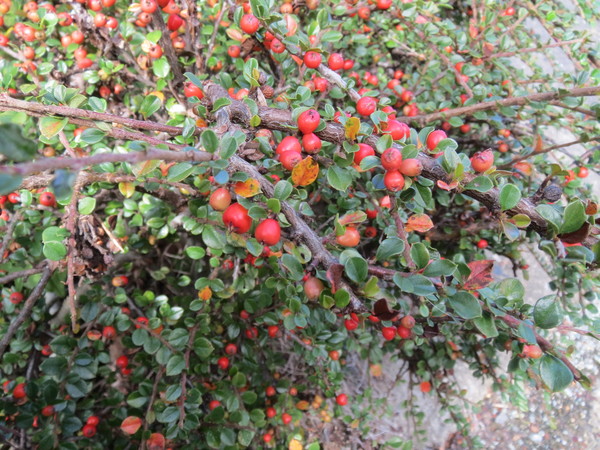
Cotoneaster horizontalis (rockspray cotoneaster, "Benishitan")
Japanese name: ベニシタン (紅紫檀)
Scientific name: Cotoneaster horizontalis
[Overview]
A deciduous to semi-evergreen shrub 0.5 m tall, sometimes about 1 m.
The branches are arranged in two rows, branch freely, and spread horizontally.
Young branches are hairy.
The leaves are simple and alternate, ovate to elliptic, 0.6–1.4 cm long and 0.4–0.9 cm wide, glossy, with entire margins.
In regions where it loses its leaves, the foliage turns red in autumn.
One or two white to pale pink 5-petaled flowers, 0.5–0.8 cm across, are borne in each leaf axil, and the flowers do not open fully.
The fruit is a pome that ripens red and remains until winter.
[Uses]
The branches, leaves and roots are used medicinally.
[Cultivation]
Propagate from seed or by cuttings.
Because the germination rate of the seeds drops sharply when they dry, remove the flesh and sow immediately, or store them so that they do not dry out.
It prefers a sunny, well-drained, fertile sandy soil, but is not particular about soil type.
For potted plants, water thoroughly when the soil surface dries; for plants in the ground, rainfall is sufficient unless the soil becomes extremely dry.
Apply slow-release or organic fertilizer twice, in winter and after flowering.
It is basically grown in its natural form without pruning, but if pruning is desired, do it in February–March.
As for pests and diseases, spider mites may appear in the high temperatures of summer.
Details
Japanese: ベニシタン(紅紫檀)、チャボシャリントウ(矮鶏車輪桃)
Translated from our Japanese encyclopedia. If anything differs, the Japanese page is correct.