
Plant Encyclopedia

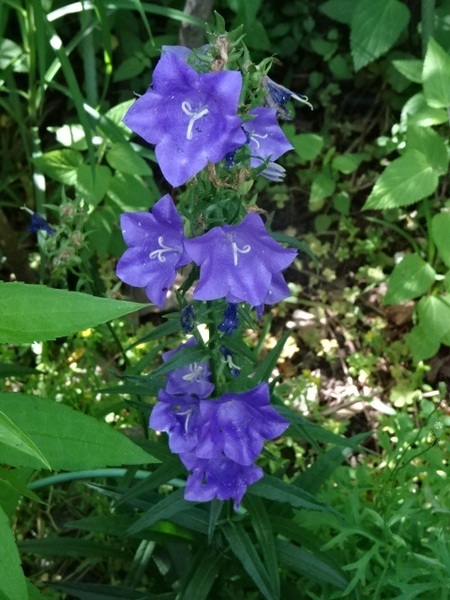
Campanula persicifolia (peach-leaved bellflower, "Momobagikyo")
Japanese name: モモバギキョウ (桃葉桔梗)
Scientific name: Campanula persicifolia
[Overview]
A perennial 30–100 cm tall.
It has a rhizome.
The stem is erect.
There are basal leaves and stem leaves; the basal leaves are lanceolate and are usually withered by the flowering season.
The stem leaves are simple and alternate, linear-lanceolate, with toothed margins.
The flowers are borne 1–3 at a time in short racemes from the stem tips or leaf axils, and open starting from the upper part of the stem.
The flowers are bell-shaped, 3–4 cm across and 3–5 cm long, and open sideways or slightly upward; the color ranges from white to wisteria blue.
The corolla has 5 lobes at the tip.
The fruit is a capsule.
[History]
It was introduced to Japan around 1930.
[Cultivation]
Propagate from seed or by division.
Divide at the places where the rhizome separates naturally.
It dislikes heat and humidity.
It prefers a well-drained place in sun to partial shade, out of the afternoon sun.
For plants in the ground, it is best planted under deciduous trees.
For potted plants, water thoroughly when the soil surface dries; for plants in the ground, rainfall is sufficient unless a spell of sunny weather makes the soil severely dry.
In spring to autumn, give diluted liquid fertilizer.
Pests and diseases seen include soft rot, powdery mildew, slugs, armyworms, spider mites and aphids.
[Notes]
The Japanese name comes from the leaves resembling peach leaves.
Details
Japanese: モモバギキョウ(桃葉桔梗)、モモノハギキョウ(桃葉桔梗)
Translated from our Japanese encyclopedia. If anything differs, the Japanese page is correct.