
Plant Encyclopedia

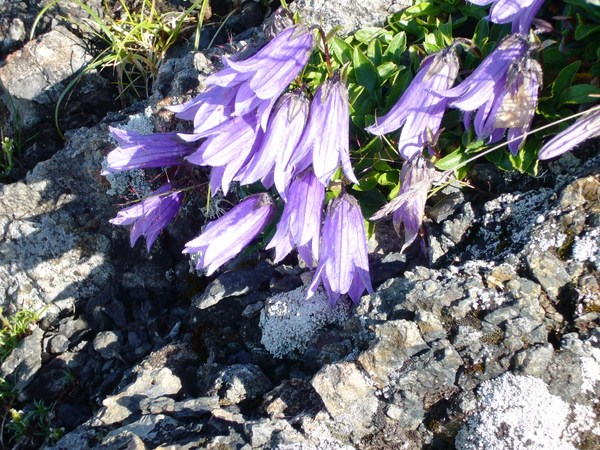
Campanula chamissonis ("Chishimagikyo")
Japanese name: チシマギキョウ (千島桔梗)
Scientific name: Campanula chamissonis
[Overview]
A perennial 5–15 cm tall, found on gravelly ground, in rock crevices, and in wind-swept grassland above the Hai-matsu zone in the high mountains.
The rhizome creeps horizontally and branches often.
There are basal leaves and leaves on the stem; the basal leaves are oblong to oblanceolate, 1.5–9 cm long and 0.5–1.5 cm wide, thick, with a glossy surface, a rounded tip, and a base that gradually narrows into a long petiole.
The leaf margins have small, wavy, blunt serrations, and there are sparse hairs on the margins and on the midrib of the underside.
The stem leaves are simple and alternate, small, and few in number.
A single flower is borne at the stem tip, often blooming sideways or slightly downward.
The flowers are bluish purple and bell-shaped, 3–4 cm long; the tip of the corolla is 5-lobed, and the margins and inner sides of the lobes bear long white hairs.
The calyx is 5-lobed, with pointed, triangular, broadly lanceolate lobes that are almost entire and bear long hairs.
[Cultivation]
Propagate from seed or by division.
It prefers well-drained soil, and soil for mountain wildflowers may be used.
It prefers a sunny place, but it dislikes heat and strong direct sunlight in summer, so in summer keep it in a cool, partially shaded place.
Water thoroughly when the soil surface dries.
Apply base fertilizer, and also give diluted liquid fertilizer in spring and autumn, making sure no fertilizer remains in midsummer.
Pests and diseases include slugs, cutworms, spider mites, aphids and soft rot.
Details
Translated from our Japanese encyclopedia. If anything differs, the Japanese page is correct.