
Plant Encyclopedia

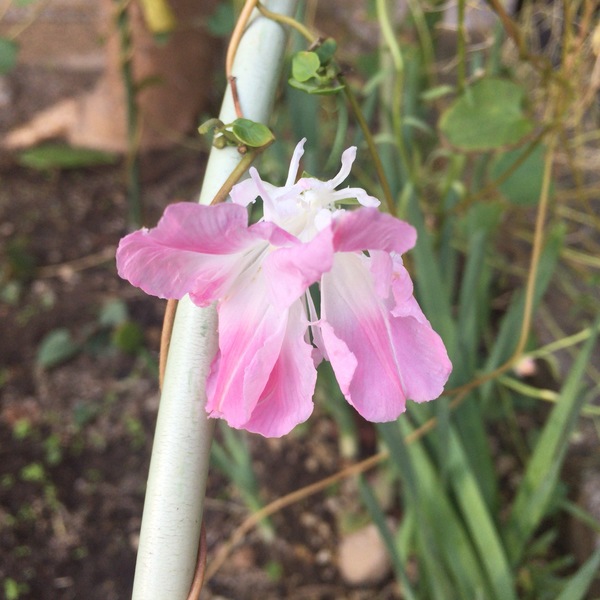
Ipomoea nil
Japanese name: 変化朝顔
Scientific name: Ipomoea nil
[Overview]
The name refers to the group of morning glories grown for their variation in flower color, flower form and leaf shape.
It is a twining annual, though there are types whose vines do not elongate.
The whole plant is densely hairy.
The leaves are alternate.
The flowers are borne in the leaf axils, opening in the morning and wilting by the afternoon.
In many henka-asagao (mutant morning glories), the pistil and stamens also turn petal-like and do not set fruit, so selection is made from seed obtained from plants of the same parent (same line) that bear normal flowers.
Flower forms include kire-zaki, kikyo-zaki, shishi-zaki and nadeshiko-zaki.
Leaf forms include imo-ba, tatsuta-ba and uzu-ba, and leaf colors include ao-ba, ki-ba and variegated leaves.
They are called by "flower names" (kamei), which are systematized according to their characteristics.
[History]
There were booms in the Edo period (the Bunka-Bunsei and Kaei-Ansei eras), during which many variations were selected.
[Cultivation]
It prefers sunny, well-drained soil rich in organic matter.
Water when the soil surface dries, but in midsummer do so in the morning and evening when the temperature is not high.
In addition to base fertilizer, give diluted liquid fertilizer about once a week.
Pests and diseases include aphids.
Details
Translated from our Japanese encyclopedia. If anything differs, the Japanese page is correct.