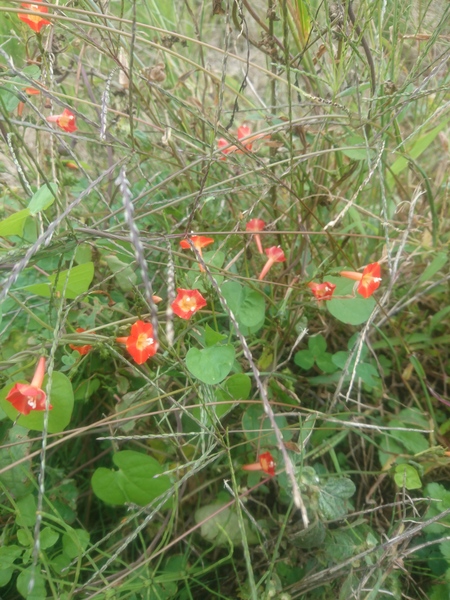
Japanese name: マルバルコウ(丸葉縷紅) Scientific name:Ipomoea coccinea
[Overview]
A climbing annual found in fields, along roadsides and on vacant land.
The vine grows to about 3 m, twines to the left, and is hairless.
The leaves are simple and alternate, broadly ovate to oval, 3–7 cm long and 1.5–5 cm wide.
The base of the leaf projects in an angular shape, but this varies a great deal.
The leaf margins are entire or have 2–3 shallow teeth.
The inflorescence arising from the leaf axil bears 2–5 flowers.
The flowers are vermilion red, 1.5–2 cm across, and pentagonal.
The fruit is a spherical capsule about 5–8 mm across.
[History]
It was introduced as an ornamental during the Kaei era (about 1848–1854) of the Edo period, and is also depicted in the Somoku Zusetsu.