
Plant Encyclopedia

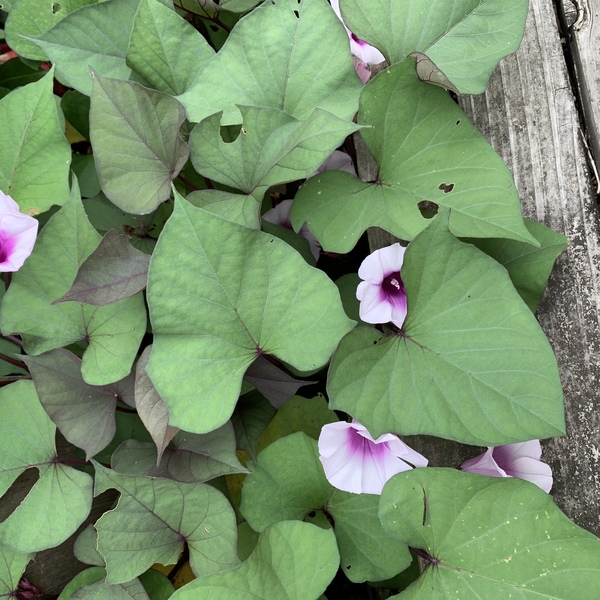
Ipomoea batatas (sweet potato, "Satsumaimo")
Japanese name: サツマイモ (薩摩芋)
Scientific name: Ipomoea batatas
[Overview]
A climbing perennial.
The long stems creep along the ground.
Leaves are alternate, heart-shaped to ovate, and some are deeply palmately cut.
The leaf margin is entire.
The flowers are funnel-shaped, 3–7 cm across, resembling those of the morning glory, and pale purplish red, sometimes white, but they are rarely seen flowering in fields.
The tuberous roots (the potatoes) are adventitious roots from the stem nodes that swell underground, and their shape and color vary.
[History]
It is thought to have originated in Mexico to Guatemala, and is said to have been cultivated in Mexico before 3,000 BC.
It was brought to Europe after Columbus's discovery of the New World in 1492.
It arrived in Japan in the early 1600s, in Okinawa to southern Kyushu.
Its spread to the Kanto region owed much to the work of Aoki Konyo in the Kyoho era.
[Uses]
The tuberous roots (potatoes) are eaten and used as a raw material for alcohol such as shochu and other distilled liquors.
The tuberous roots and vines are also used as fodder.
It is also sold as a foliage plant.
[Cultivation]
It varies by cultivation type, but seedlings are usually planted in May–June and harvested in September–November.
It prefers sunny, well-aerated, poor, slightly acidic soil.
Watering is not needed unless the soil becomes severely dry.
Too much fertilizer produces only vine growth without the potatoes thickening ("tsuru-boke", excessive vine growth), so use little fertilizer or none.
If fertilizer is applied, use only a minimum of base fertilizer and no additional fertilizer.
Fertilizer high in nitrogen also causes excessive vine growth, so use a higher proportion of potassium.
Cultivate the soil deeply and well, and to improve drainage and aeration it is good to make high ridges about 30 cm tall.
Laying black mulch prevents weeds.
Plant seedlings at a slant so that 3–4 nodes are buried in the soil, and water thoroughly after planting.
If left alone, the vines keep spreading, so regularly performing "vine turning" (lifting the extended vines off the ground and cutting the adventitious roots growing from the nodes) allows it to be grown even in a small space.
"Vine turning" also prevents too many potatoes from forming and the nutrients being dispersed.
For harvest, judge the timing by a trial dig, dig them up in the morning on a fine day, and dry the surface in the sun.
Cold damages the potatoes, so finish harvesting before frost falls.
Pests and diseases include black spot, damping-off, mottle mosaic disease, grubs of scarab beetles, cutworms, sweet potato hornworm larvae, wireworms, sweet potato root-knot nematode and sweet potato leaf miner moths.
Details
Japanese: サツマイモ(薩摩芋)、スイートポテト、カライモ(唐藷)、カンショ(甘藷)、バンショ(番藷)、リュウキュウイモ(琉球藷)
Translated from our Japanese encyclopedia. If anything differs, the Japanese page is correct.