
Plant Encyclopedia

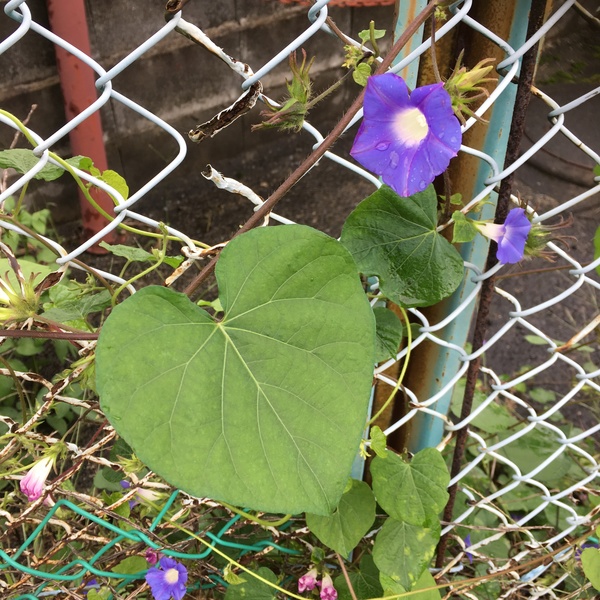
Ipomoea hederacea var. integriuscula ("Marubaamerikaasagao")
Japanese name: マルバアメリカアサガオ
Scientific name: Ipomoea hederacea var. integriuscula
[Overview]
A climbing annual found along roadsides and similar places.
The vine branches freely and twines around other objects.
The vine is densely covered with coarse, downward-pointing hairs.
The leaves are simple and alternate, oval, 3–8 cm long and 3–7 cm wide, with pointed tips.
Both sides of the leaf have sparse hairs, and the leaf margins are entire or have 2–3 shallow teeth.
The leaves have long petioles.
The flowers are borne 1–3 at a time in the leaf axils and are funnel-shaped, 3 cm across.
The flower color is mainly blue-purple, but pink, reddish purple, white and others also occur.
The calyx is thick and fleshy, about 2 cm long, and deeply divided into 5 lobes; the lobes are broad at the base and narrow abruptly from the middle, with the margins folded inward like a gutter and the tips curved back.
The outside of the calyx is fairly densely covered with long hairs.
Two bracts grow opposite each other on the upper part of the flower stalk; the bracts are linear and 1–1.5 cm long.
The fruit is a flattened spherical capsule that points upward.
[Cultivation]
Propagate from seed.
It prefers sunny, well-drained soil rich in organic matter.
The seeds do not germinate when temperatures are low, so sow them in May–June, when the temperature rises above 20°C.
The seed coat is hard, so make a slight cut in the surface with a cutter or similar and soak the seeds in water for a day and a night; this makes it easier for the cotyledons to open.
At this time, take care not to cut too deeply, and not to damage the white part called the hilum (heso, "navel").
Keep watering until germination so that the seeds do not dry out.
After germination, plant out when 3–4 true leaves have appeared.
Water when the soil surface dries; in midsummer, water in the morning and evening when the temperature has not risen.
Besides base fertilizer, give diluted liquid fertilizer about once a week after planting out.
Aphids can occur.
Details
Translated from our Japanese encyclopedia. If anything differs, the Japanese page is correct.