
Plant Encyclopedia

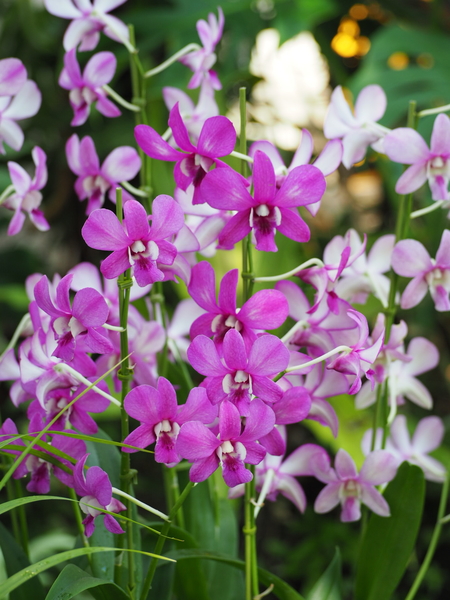
Dendrobium (genus)
Japanese name: デンファレ
Scientific name: Dendrobium
[Overview]
A group of hybrids bred from several wild species.
An epiphytic evergreen perennial 20–100 cm tall.
The rhizome is short and produces many roots.
The fleshy, rod-like stems grow in clumps.
The lower part of the stem is covered by leaf sheaths.
The leaves are simple and alternate, elliptic to oblong or ovate, with entire margins.
Several long flower stalks emerge from the leaf axils in the upper part of the stem, bearing several to 20 flowers.
The flower stalks stand upright or curve in an arch.
Flower colors include white to reddish purple, bicolors, yellowish green and cream.
The dorsal sepal and lateral sepals are oblong to lanceolate, and the lateral petals are rounded and ovate.
The lip is slightly 3-lobed, and its base curls upward to enclose the column.
[Uses]
The flower stalks grow long, the plants bear many flowers that last well, and the flower colors are varied, so it is well suited to cut flowers.
[History]
It was bred mainly from Dendrobium phalaenopsis (D. phalaenopsis) and Dendrobium bigibbum (D. bigibbum), together with D. discolor, D. gouldii, D. antennatum, D. macrophyllum, D. spectabile, D. canaliculatum and others.
[Cultivation]
Propagate by division and by taking offsets (keiki).
Grow it in a sunny, airy place where it can be kept at 18°C or higher throughout the year.
Below 18°C the leaves turn yellow and begin to fall.
Even if the leaves fall, if the stems are green, leaves will grow again from spring onward.
Direct summer sun can cause leaf scorch.
Plant it in sphagnum moss.
From spring to summer, water thoroughly when the surface of the potting material dries, and keep it somewhat on the dry side when temperatures drop.
Apply liquid fertilizer once a week from the time new shoots grow until autumn.
Pests and diseases include viral disease, spider mites, scale insects, aphids and slugs.
[Notes]
The name means a Dendrobium whose flowers resemble those of the moth orchid (Phalaenopsis), and derives from the scientific name of the wild species that is the basis of the crossing.
Details
Translated from our Japanese encyclopedia. If anything differs, the Japanese page is correct.