
Plant Encyclopedia

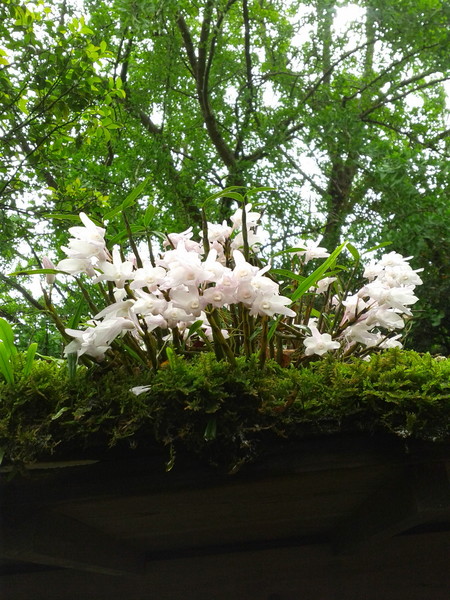
Dendrobium moniliforme ("Sekkoku")
Japanese name: セッコク (石斛)
Scientific name: Dendrobium moniliforme
[Overview]
An evergreen perennial 10–25 cm tall that grows as an epiphyte on trees and rocks.
The rhizome is short and produces many roots.
Fleshy, cylindrical stems about 20 cm long and 3–5 mm in diameter grow in clumps.
The internodes are 2–4 cm long, and young stems are covered by leaf sheaths.
Old stems have no leaves and are yellowish brown.
The leaves are simple and alternate in two rows, lanceolate, about 4–7 cm long and 7–1.5 cm wide, glossy on the upper surface, with entire margins.
The flowers emerge one or two at a time from the upper nodes of the leafless stems; they are about 3 cm across, white to pale pink, and fragrant.
The dorsal sepal, lateral sepals and lateral petals are oblong to lanceolate.
The lip is ovate-rhombic and slightly 3-lobed, with an ovate, recurved middle lobe.
[Uses]
The leaves tend to vary, and many "variant-leaf" cultivars have been distinguished and prized since the Edo period.
It is also used as a crude drug.
[Cultivation]
Propagate by division, by removing plantlets from the stem, or by yabuse (laying cut stems flat).
Grow it in a sunny, well-ventilated place out of direct summer sun.
Strong summer sunlight can scorch the leaves, so take care.
Plant it in sphagnum moss, or attach it to a tree fern board or a piece of wood.
It dislikes excess moisture, so water only after the planting material has dried.
It is good to apply diluted liquid fertilizer several times when the new shoots are growing.
Pests and diseases include viral disease, spider mites, scale insects, aphids and slugs.
Details
Translated from our Japanese encyclopedia. If anything differs, the Japanese page is correct.