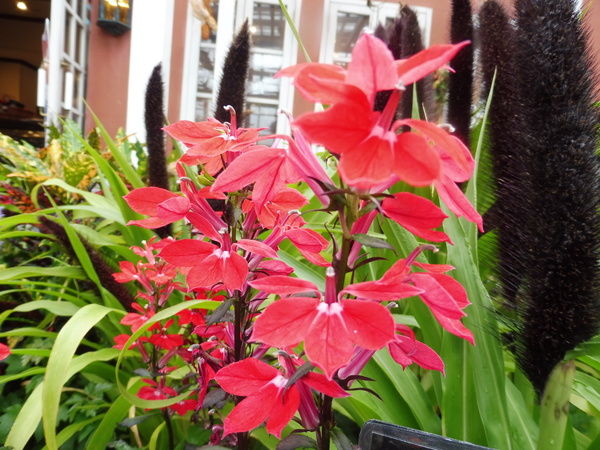
Japanese name: ベニバナサワギキョウ(紅花沢桔梗) Scientific name:Lobelia cardinalis
[Overview]
A perennial about 1.2 m tall, found on riverbanks, in swamps and in wetlands in its native habitat.
The stem is erect and often reddish.
The leaves are simple and alternate, lanceolate, about 20 cm long and 5 cm wide, with toothed margins.
A raceme about 30 cm long at the stem tip bears bracts in the inflorescence.
The flowers are scarlet and two-lipped, 4 cm long; the upper lip is 2-lobed and the lower lip is 3-lobed.
The fruit is a capsule.
[History]
It was introduced to Europe in the mid-1620s.
[Uses]
It is poisonous.
The leaves were used as a substitute for tobacco and as an external medicine for rheumatism and similar conditions.
[Cultivation]
Propagate by division, stem cuttings, or seed.
It prefers a sunny, airy, fertile, moist environment and dislikes dryness.
Avoid strong afternoon sun in midsummer.
Move potted plants to airy partial shade in midsummer.
For potted plants, water thoroughly when the soil surface dries, until water runs out of the bottom of the pot.
Apply slow-release fertilizer as a base fertilizer, and also fertilizer placed on the soil in spring and autumn.
There are no particular pests or diseases.