
Plant Encyclopedia

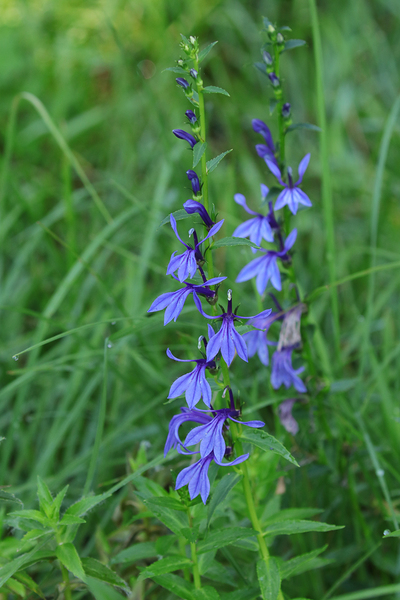
Lobelia sessilifolia ("Sawagikyo")
Japanese name: サワギキョウ (沢桔梗)
Scientific name: Lobelia sessilifolia
[Overview]
A perennial 0.5–1.2 m tall, growing in wetlands.
A short, thick rhizome creeps horizontally, and it often grows in clumps.
The stem is hollow and erect.
The leaves are simple and alternate, lanceolate, 4–7 cm long, with low teeth, and have no leaf stalks.
A raceme at the stem tip bears densely packed flowers, which open in order from the bottom.
The inflorescence has bracts.
The flowers are purple and two-lipped, 3 cm long; the upper lip is deeply 2-lobed and the lower lip is shallowly 3-lobed, with long hairs on the margins of the lobes.
There are 5 stamens, and the two lower anthers have a tuft of hairs at the tip.
The fruit is a spherical capsule.
The seeds are flat and egg-shaped with a gloss, and one side is thin and wing-like.
[Cultivation]
Propagate by division, shoot cuttings, or from seed.
It prefers a sunny, well-ventilated, fertile, moist environment and dislikes dryness.
Avoid the strong afternoon sun in midsummer.
Take care that it does not run short of water; for potted plants, water thoroughly when the soil surface dries, until water runs out of the bottom of the pot.
Watering from a tray of water placed under the pot is also possible, but take care that the water temperature does not rise too high and the water quality does not deteriorate.
No fertilizer is particularly needed if base fertilizer is applied, but for potted plants, a small amount of slow-release fertilizer may be placed on the soil in spring and autumn, depending on growth.
Stagnant water causes root rot.
There are no particular pests or diseases.
Details
Translated from our Japanese encyclopedia. If anything differs, the Japanese page is correct.