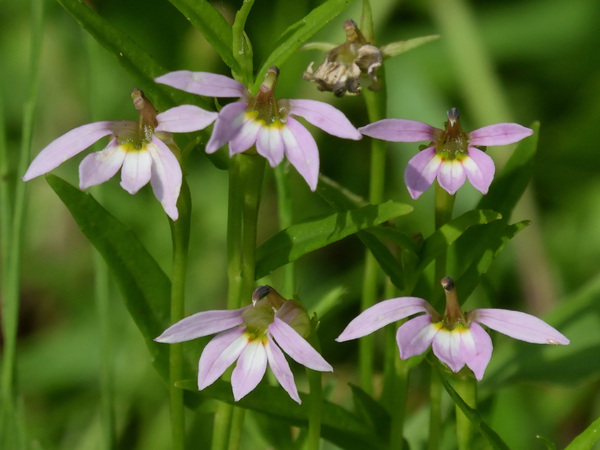
Japanese name: ミゾカクシ(溝隠) Scientific name:Lobelia chinensis
[Overview]
A perennial about 10–15 cm tall, found on the banks of rice paddies and in ditches.
The stem branches well at the base and creeps along the ground, with the upper part rising upright.
The leaves are simple, sparsely arranged alternately in two rows, oblong and about 1–2 cm long, with wavy teeth on the margins.
The flowers are borne singly in the leaf axils in the upper part of the stem and are white to pale reddish purple.
The corolla is two-lipped and 1 cm long, but the lobes are deeply divided into nearly equal sizes, with 2 pointing sideways and 3 pointing downward, spreading like a fan.
The tips of the lobes are pointed.
The fruit is a capsule, but many plants do not set fruit.
[Uses]
Although poisonous, it is used medicinally.
[Cultivation]
Propagate by division.
It prefers a sunny, moist environment and dislikes dryness.
Take care that it does not dry out when watering; for potted plants, watering from a tray of water placed under the pot is also acceptable.
Apply slow-release fertilizer as a base fertilizer; for potted plants, also bury fermented oil cake in the soil about once every 2 months from spring to autumn.
There are no particular pests or diseases.