
Plant Encyclopedia

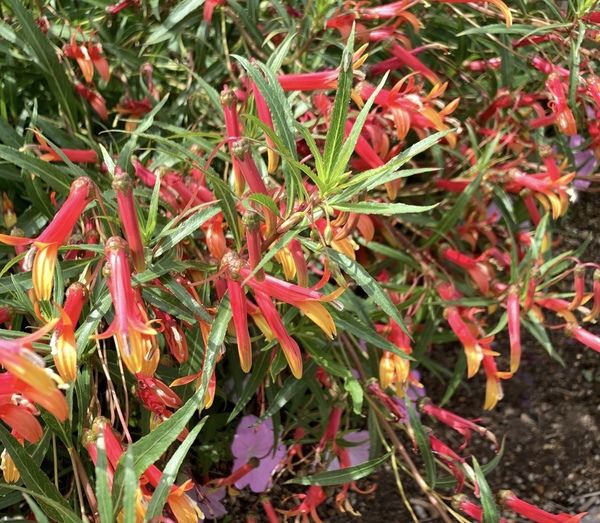
Lobelia laxiflora (Mexican bush lobelia)
Japanese name: ロベリア ラクシフロラ
Scientific name: Lobelia laxiflora
[Overview]
A perennial 0.9–1.5 m tall with a clump width of 1.2–1.8 m, sometimes reaching 3 m in height.
In warm regions it is evergreen.
It spreads by extending underground stems.
The stems arch and grow long, and are tinged with red.
The leaves are simple and alternate, linear to narrowly lanceolate, with fine teeth on the margins.
A raceme about 40 cm long bears two-lipped, tubular flowers about 4–6 cm long.
The inflorescence has bracts similar in shape to the leaves.
In the corolla, the upper lip is deeply 2-lobed and the lower lip is shallowly 3-lobed; the outside is red and the inside is yellow.
The stamens and pistil protrude from between the upper lips, and the anthers are hairy.
The flowers have long stalks.
The fruit is a capsule.
[Cultivation]
Propagate by cuttings.
It grows quickly.
It prefers a sunny, well-drained, fertile, moist environment.
It is cold-hardy, but wet soil in winter causes root rot, so protect it from rain, snow and frost with mulch, or grow it in a pot and move it indoors.
Even if the aboveground parts die back in winter, it will sprout in spring as long as the roots do not freeze.
Avoid strong afternoon sun in midsummer; grow it in a pot and move it to airy partial shade in midsummer.
For potted plants, water thoroughly when the soil surface dries; for plants in the ground, established plants tolerate dryness, but water if the soil is dry.
For fertilizer, place slow-release chemical fertilizer on the soil once a month.
Cutting it back before the rainy season makes it easier to get through summer.
Pests and diseases include spider mites, greenhouse whiteflies and aphids.
Details
Japanese: ロベリア ラクシフロラ
Translated from our Japanese encyclopedia. If anything differs, the Japanese page is correct.