
Plant Encyclopedia

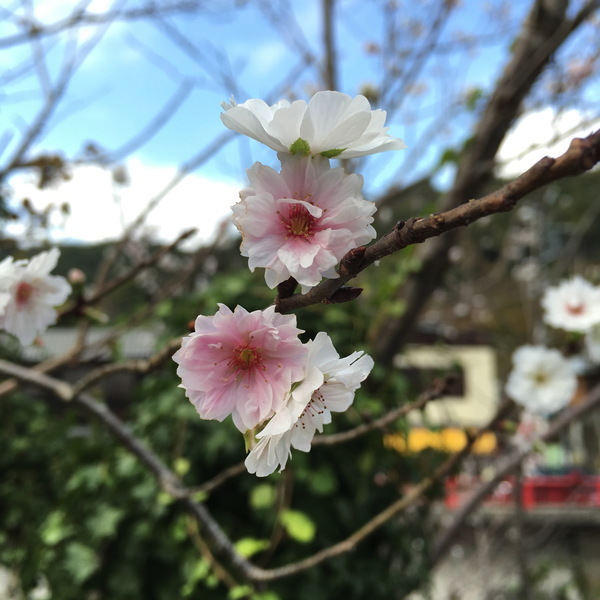
Cerasus ‘Kobuku-zakura’ ("Kobukuzakura")
Japanese name: コブクザクラ (子福桜)
Scientific name: Cerasus ‘Kobuku-zakura’
[Overview]
A cultivar presumed to be a hybrid of Shinami-zakura and Jugatsu-zakura (or Edo-higan).
A deciduous tree.
Aerial roots emerge from the points where the trunk divides.
Young branches are green.
The leaves are simple and alternate, oblong, 3–8 cm long and 1.5–3.5 cm wide.
The upper surface of the leaf is glossy, and the veins on the underside and the petiole bear upward-pointing hairs.
The leaf margin has sharp double serration.
The flowers are borne 2–4 to an umbel arising from the leaf axils; they are about 2.5–3.5 cm across with 20–50 petals, changing from white to pale pink.
There are 40–50 stamens.
There are 1–5 pistils, and the style is hairless.
It blooms from around October until the new year and again in spring, flowering twice a year.
The calyx tube is bell-shaped to urn-shaped, slightly constricted at the top, and the calyx lobes have coarse serration in the upper half.
In winter flowers there is almost no flower stalk and the pedicel is 0.5 cm long; in spring flowers the flower stalk is 1 cm long and the pedicel is 2.5 cm long with upward-pointing hairs.
The fruit ripens black.
Because one flower has several pistils, 1–3 fruits are borne joined together.
[History]
It is widely seen in Atami and the Kansai region and is also found in Angyo, Kawaguchi, but its origin is unclear.
Tsunoda Haruhiko presumes it to be Shinami-zakura × Jugatsu-zakura, and Oi Jisaburo presumes it to be Shinami-zakura × Edo-higan.
[Cultivation]
Propagate by cuttings or grafting.
It prefers a sunny, well-drained site.
If it becomes a problem by growing into a large tree in a garden, it is good to restrict the space available to the roots with a fabric pot in order to control the size of the tree.
While it is a young tree, protect it from frost by spreading straw around the base.
Also, it is better not to cut the branches needlessly.
It suffers from many pests and diseases, so care is needed.
[Notes]
The Japanese name comes from the way it bears many fruits.
Details
Translated from our Japanese encyclopedia. If anything differs, the Japanese page is correct.