
Plant Encyclopedia

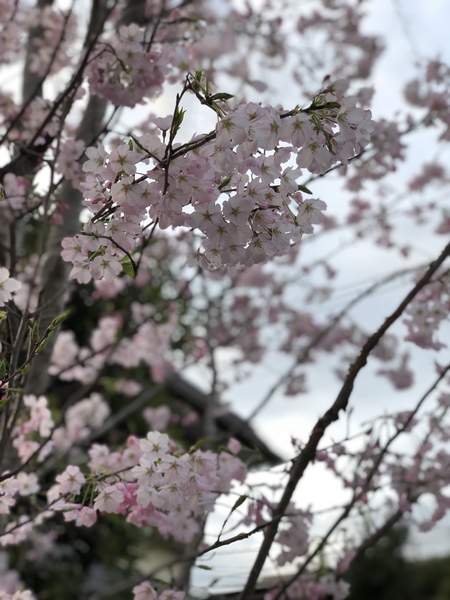
Cerasus ‘Jindai-akebono’
Japanese name: 神代曙
Scientific name: Cerasus ‘Jindai-akebono’
[Overview]
A cultivar of the Edo-higan group.
A deciduous tree.
The leaves are simple and alternate, oblong-oblanceolate.
The upper surface of the leaf is glossy, and the veins on the underside and the petiole bear many upward-pointing hairs.
The leaf margin has a mixture of double and single serration.
It flowers before the leaves unfold.
The flowers are borne 3–5 to an umbel arising from the leaf axils; they are 5-petaled, about 3.5 cm across, and pale reddish purple.
The petal tips are slightly darker.
The lower half of the style is hairy.
[History]
The original tree is in Jindai Botanical Garden in Tokyo.
In 1965 a cultivar called 'Akebono' in the United States was introduced to Jindai Botanical Garden, but since a different cultivar called 'Akebono' already existed in Japan, it came to be called 'America'.
This cultivar arose from among plants raised by grafting this 'America'.
Nishida Naomichi showed it to be a different cultivar, and Hayashi Yaei named it after the planting site and the old name at the time of introduction.
[Cultivation]
Propagate by cuttings or grafting.
It prefers a sunny, well-drained site.
If it becomes a problem by growing into a large tree in a garden, it is good to restrict the space available to the roots with a fabric pot in order to control the size of the tree.
While it is a young tree, protect it from frost by spreading straw around the base.
Also, it is better not to cut the branches needlessly.
It suffers from many pests and diseases, so care is needed.
[Notes]
The Japan Flower Association (a public interest incorporated foundation) recommends this cultivar, whose flowering period is close and whose flowers are similar, as a substitute for Somei-yoshino, which is susceptible to witches' broom.
Details
Translated from our Japanese encyclopedia. If anything differs, the Japanese page is correct.