
Plant Encyclopedia

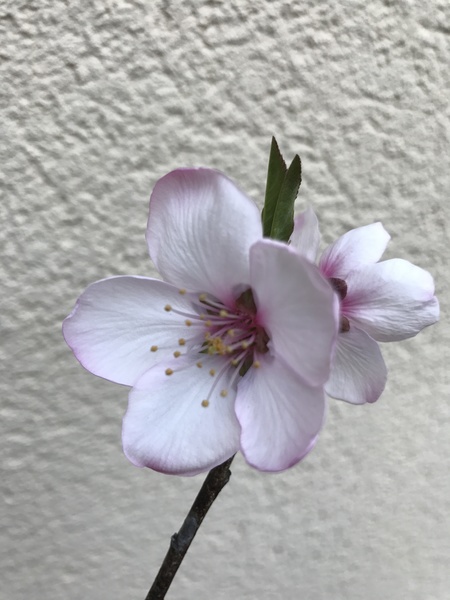
Amygdalus communis (almond, "Hento")
Japanese name: ヘントウ (扁桃)
Scientific name: Amygdalus communis
[Overview]
This is the so-called almond tree.
A deciduous tree 6–9 m tall.
The leaves are simple and alternate, elliptic-lanceolate.
The leaf margins are serrate.
The leaves resemble those of Momo, but are slightly glossier.
The flowers are usually solitary and open before the leaves emerge.
The flower is five-petaled, about 4 cm across, and white to pale pink.
The fruit consists of the endocarp, the mesocarp and exocarp, and the seed.
The fruit takes more than half a year to ripen, and as ripening approaches it dries naturally and splits open.
The seed (kernel) taken from this fruit is what is used.
By the hardness of the stone, the plants are divided into hard-stone and soft-stone types, and the soft-stone types are further divided into bitter types (bitter almond) and sweet types (sweet almond).
[Uses]
The seed (kernel) taken from the fruit is used as food and medicine.
The bitter types have a bitter taste and are unsuitable for eating, so they are used medicinally or as rootstocks.
What is eaten as almonds are the sweet types and some of the hard-stone types.
[Cultivation]
It prefers land with good drainage and sunlight and deep topsoil.
Propagate by grafting, using cut grafting in March or budding in August–September.
Pests and diseases are very numerous, so care is needed.
Details
Japanese: ヘントウ(扁桃)、アーモンド、アメンドウ、カラモモ
Translated from our Japanese encyclopedia. If anything differs, the Japanese page is correct.