[Overview]
A small deciduous tree.
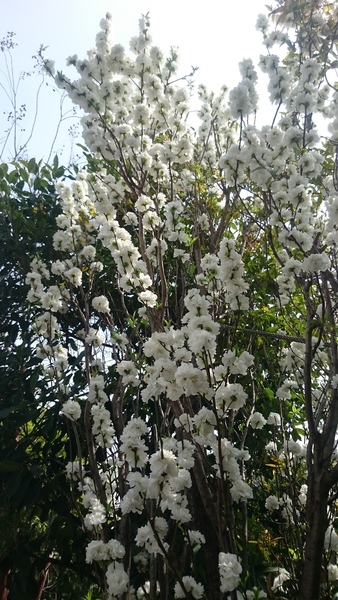
This is a peach grown for its flowers.
The leaves are simple and alternate, elliptic-lanceolate, about 8–15 cm long, with coarse serrations along the margin.
There are glandular dots at the base of the leaf.
The petiole is 1–1.5 cm long.
The flowers often open before the leaves unfold and are usually solitary.
There are single 5-petaled, semi-double and double forms, and the flower color varies among white, pink and deep red.
The fruit surface is covered with hairs.
[History]
Like the ume, it came from China in ancient times, and its name appears in the Kojiki and the Man'yoshu.
Improvement for flower viewing began only in the Edo period.
It is used as a decoration for the Peach Festival on March 3.
[Cultivation]
Propagate by cuttings or grafting, using cleft grafting in March or bud grafting in August–September.
It prefers fertile soil that is sunny and well drained.
In poor sunlight, flowering is poor.
For potted plants, water thoroughly when the soil surface dries.
For plants in the ground, rainfall is sufficient, but in summer, when the soil dries easily, water in the morning or evening when temperatures are low.
Apply organic fertilizer in winter.
Pests and diseases are very numerous, so care is needed.