
Plant Encyclopedia

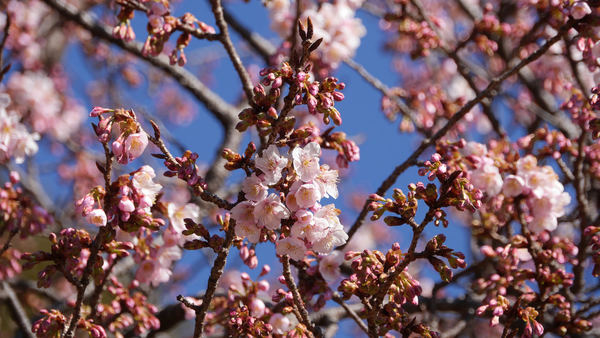
Cerasus ×kanzakura ‘Praecox’
Japanese name: カンザクラ (寒桜)
Scientific name: Cerasus ×kanzakura ‘Praecox’
[Overview]
A cultivar of the Kanhi-zakura group, presumed to be a hybrid of Kanhi-zakura and Yama-zakura.
A small to large deciduous tree.
The bark is blackish purplish brown.
Leaves are simple and alternate, obovate to obovate-elliptic, 6–12 cm long and 3–5 cm wide, with a shortly tailed-pointed tip and a rounded base.
The leaf margin has a mixture of simple and double serrations.
The upper surface is slightly glossy, and the underside is slightly whitish.
The petiole is about 1–1.5 cm long, tinged dark purplish brown, and has 1–2 nectaries a little below its upper end.
The young shoots are brown tinged with reddish purple.
The flowers are borne 2–3 in umbels from the leaf axils; they are pale pink, 5-petaled, and about 2.5 cm across.
The petals are broadly ovate-round with a notch at the tip.
The flowers open at the same time as the young leaves unfold, and the earliest begin flowering in January.
The bud scales also have short curly hairs at the tip of the outer surface.
The calyx tube is bell-shaped, about 5 mm long, and dark reddish purple; the sepal lobes are oblong-lanceolate, about 3.5 mm long, reddish purple, entire, and have marginal hairs.
[Cultivation]
Propagate by cuttings or grafting.
It prefers a sunny, well-drained site.
If it grows into a large tree in the garden and becomes a problem, it is good to limit the space for root growth with a fabric pot in order to control the size of the tree.
While it is a young tree, protect it from frost by, for example, spreading straw around the base.
Also, it is better not to cut branches needlessly if there is no need.
It is prone to many pests and diseases, so care is needed.
Details
Translated from our Japanese encyclopedia. If anything differs, the Japanese page is correct.