EVERGREEN

Plant Encyclopedia

Jasminum sambac

Jasminum sambac (Arabian jasmine, "Matsurika")

Japanese name: マツリカ (茉莉花)
Scientific name: Jasminum sambac

Jasminum sambac

[Overview]
An evergreen climbing shrub.
The twigs are densely covered with soft hairs.
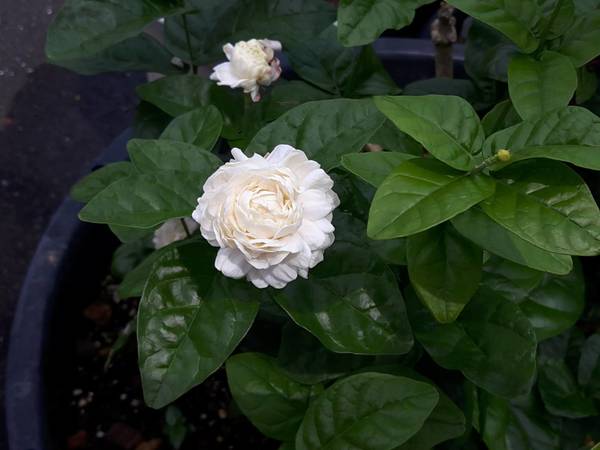
The leaves are simple, opposite or in whorls of 3, broadly ovate, 5–12 cm long and 3–9 cm wide, hairless, with conspicuous veins.
The flowers are borne 3–12 in cymes at the branch tips.
The flowers are white and salverform, and the corolla has 5 lobes, but there are also garden cultivars with double flowers.

[History]
There is a record that in 1614 Shimazu Iehisa presented it to Tokugawa Ieyasu in Japan.

[Uses]
The flowers have a strong fragrance, and perfume and tea made from the flowers are famous.
It is regarded as the national flower in Indonesia and the Philippines, and is used for leis in Hawaii and elsewhere.

[Cultivation]
Propagate by cuttings.
It prefers a sunny location and sandy soil.

Details

Names
English: Arabian jasmine, zambac
Japanese: マツリカ(茉莉花)、アラビアジャスミン、モウリンカ(毛輪花)
Life form
Woody climber
Evergreen / deciduous
Evergreen
Leaf type
Broadleaf
Habit
Terrestrial
Planting (or sowing) season
March, April, September, October
Flowering season
July, August, September
Distribution or origin
Southeast Asia
Growth form
Climbing
Leaf shape
Simple leaf
Leaf arrangement
Opposite, Whorled
Leaf margin
Entire
Inflorescence
Cyme
Flower color
White
Leaf color
Green
Availability of seeds and plants
Low
Form sold
Seedlings
Propagation
Cuttings
Sun exposure
Full sun
Soil needs
Required
Suitable uses
Potted plant, Parks and gardens, Wall greening, Container, Balcony
Pests
Aphids, Spider mites
Uses
Essential oil
Japan Flower Trade Code
58228

Translated from our Japanese encyclopedia. If anything differs, the Japanese page is correct.

Sponsored