EVERGREEN

Plant Encyclopedia

Jasminum nudiflorum

Jasminum nudiflorum (winter jasmine, "Obai")

Japanese name: オウバイ (黄梅)
Scientific name: Jasminum nudiflorum

Jasminum nudiflorum

[Overview]
A deciduous shrub 1–1.5 m tall.
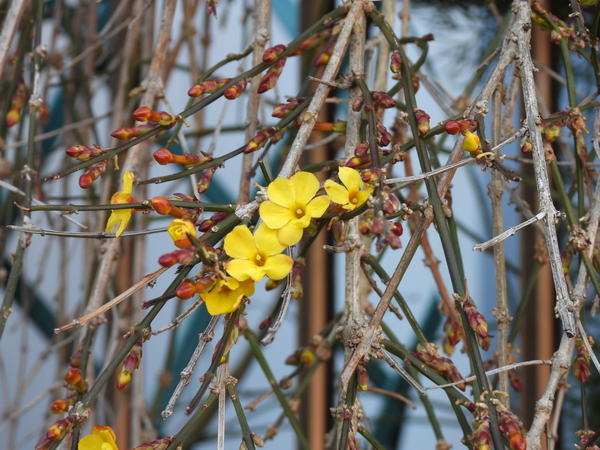
The stems are green with 4 ridges, and the tips droop.
When horizontally extending branches touch the ground, they root from the nodes.
The leaves are opposite, composed of 3 leaflets, with entire margins.
The flowers are borne singly in the leaf axils and bloom in February–March before the leaves emerge.
The flowers are yellow, 2–2.5 cm across, salverform, with 6 lobes.

[History]
It is said to have been introduced to Japan before the Kanbun era (1661–73).

[Cultivation]
Propagate by cuttings or layering.
It prefers a sunny site and sandy soil.
Because the branches droop, it suits slopes and the tops of stone walls.
The flowers are borne on the previous year's branches, so prune immediately after flowering.

Details

Names
English: winter jasmine
Japanese: オウバイ(黄梅)
Life form
Shrub
Evergreen / deciduous
Deciduous
Leaf type
Broadleaf
Habit
Terrestrial
Planting (or sowing) season
March, April, September, October
Flowering season
February, March, April
Distribution or origin
China (Shandong, Henan to Sichuan, Yunnan)
Growth form
Branching
Height
1000–1500 mm
Leaf shape
Trifoliate compound leaf
Leaf arrangement
Opposite
Leaf margin
Entire
Inflorescence
Solitary
Flower color
Yellow
Flower diameter
20–25
Leaf color
Green
Availability of seeds and plants
Low
Form sold
Seedlings
Propagation
Cuttings, Layering
Sun exposure
Full sun
Soil needs
Required
Tolerance
Cold tolerance
Suitable uses
Bonsai, Hedge, Parks and gardens
Pests
Aphids, Spider mites
Japan Flower Trade Code
21958

Translated from our Japanese encyclopedia. If anything differs, the Japanese page is correct.

Sponsored