EVERGREEN

Plant Encyclopedia

Euphyllophyta
Angiospermae
Ericales
Theaceae
Camellia
Camellia sasanqua ‘Shishigashira’

Camellia sasanqua ‘Shishigashira’ ("Kantsubaki")

Japanese name: カンツバキ (寒椿)
Scientific name: Camellia sasanqua ‘Shishigashira’

Camellia sasanqua ‘Shishigashira’

[Overview]
Although it has "tsubaki" (camellia) in its name, it is a cultivar of sasanqua (Sazanka).
The branches spread strongly horizontally, and the twigs are hairy at first.
Unlike camellia, the leaves have hairs on the stalk and on the midrib on both sides, and lack the scattered blackish-brown dots on the underside.
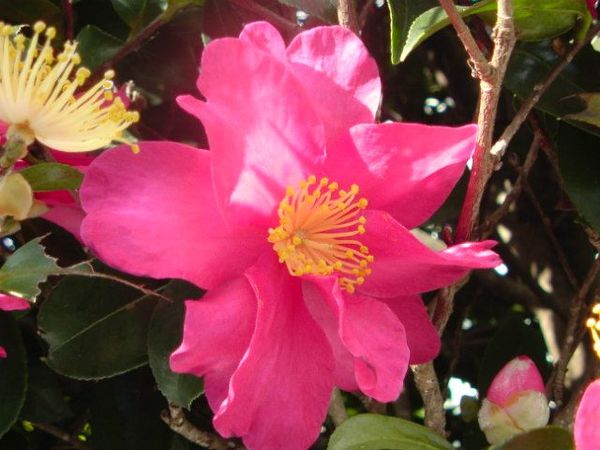
The flowers are borne at the branch tips and are red, medium-sized and double.
When they fall, the petals drop separately.
It is the plant that was called 'Shishigashira' in the Kansai region, and is said to have come to be called "Kantsubaki" in the Kanto region from 1933 onward.
The so-called Tachi-kantsubaki (upright Kantsubaki) is a different cultivar known as 'Kanjiro'.

[Cultivation]
It is strongly resistant to cold and to salt wind.
Care is needed against the tea tussock moth (Chadokuga).

Details

Names
Japanese: カンツバキ(寒椿)、サザンカ‘獅子頭’
Life form
Shrub
Evergreen / deciduous
Evergreen
Leaf type
Broadleaf
Habit
Terrestrial
Planting (or sowing) season
March, April, September, October
Flowering season
December, January, February
Growth form
Upright
Leaf shape
Simple leaf
Leaf arrangement
Alternate
Leaf margin
Serrate
Inflorescence
Solitary
Flower color
Red
Leaf color
Green
Availability of seeds and plants
Low
Form sold
Seedlings
Sun exposure
Full sun
Soil needs
Required
Tolerance
Cold tolerance, Salt-laden wind tolerance
Suitable uses
Bonsai, Cut flowers, Potted plants, Hedge, Parks and gardens
Diseases
Leaf gall
Pests
Tea tussock moth, Aphids, Scale insects
Japan Flower Trade Code
23714

Translated from our Japanese encyclopedia. If anything differs, the Japanese page is correct.

Sponsored