
Plant Encyclopedia

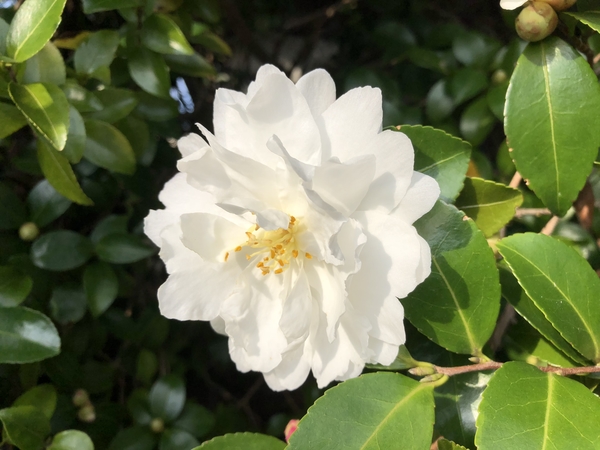
Camellia sasanqua (sasanqua camellia, "Sazanka")
Japanese name: サザンカ (山茶花)
Scientific name: Camellia sasanqua
[Overview]
An evergreen small tree about 5 m tall.
Young branches have coarse hairs or long soft hairs.
Leaves are simple and alternate, elliptic, 4–8 cm long.
They are thick, dark green and glossy on the upper surface.
The leaf margins have blunt serrations.
There are hairs on the midrib on both sides of the leaf.
The petiole is 2–5 mm long and hairy on the upper side.
The flowers usually grow singly (rarely in pairs) in the axil of the first scale leaf of the winter bud.
The flowers are white, 5–8 cm across, with usually 5 petals that are narrowly elliptic to ovate-elliptic and 2.5–3.5 cm long.
Unlike the camellia (Tsubaki), the bases of the petals and the bases of the stamens are not fused, so the petals fall separately.
There are many stamens.
The fruit is a spherical capsule 1.5–1.8 cm across, with a thick pericarp containing 3 seeds 1.0–1.5 cm long.
The fruit splits open when ripe.
The flowers of the original species are white, but there are many cultivars, and their flower colors and shapes vary.
[Cultivation]
Propagate by cuttings or layering.
It grows from sun to shade, but it is best to avoid places exposed to afternoon sun and places in overly dark shade.
Avoid the north wind in winter as well, and provide protection from the cold where temperatures fall below -5°C in winter.
It prefers well-drained, fertile, weakly acidic soil.
Water thoroughly when the soil surface dries.
For plants in the garden, once they have taken root no watering is particularly needed unless it becomes severely dry.
For plants in the garden, apply fertilizer in winter in January–February; for potted plants, apply slow-release fertilizer in September and after flowering.
If the soil becomes biased toward alkaline, it is good to give a physiologically acidic fertilizer (such as ammonium sulfate).
Pests and diseases include sooty mold, tea tussock moth (Chadokuga) and scale insects.
In particular, the tea tussock moth can cause a skin rash just from touching it, so caution is needed.
Details
Japanese: サザンカ(山茶花)、オキナワサザンカ(沖縄山茶花)
Translated from our Japanese encyclopedia. If anything differs, the Japanese page is correct.