
Plant Encyclopedia

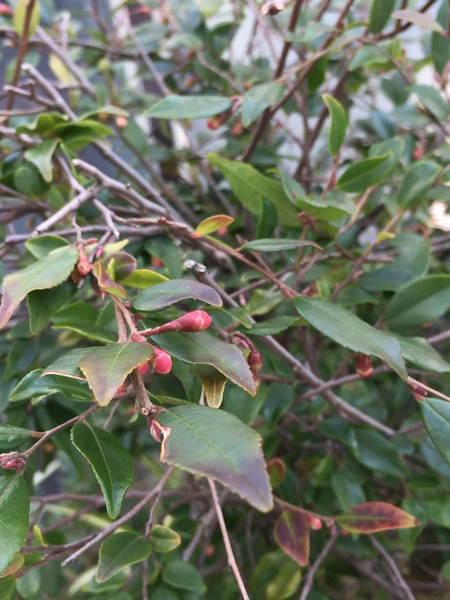
Camellia lutchuensis ("Himesazanka")
Japanese name: ヒメサザンカ (姫山茶花)
Scientific name: Camellia lutchuensis
[Overview]
An evergreen small tree about 10 m tall.
It is distributed in the Ryukyu Islands, and is found along mountain streams in valleys and in partially shaded places in forests.
Young branches are slender, with short, spreading soft hairs.
The leaves are simple and alternate, elliptic to oblong-ovate, 1.5–3 cm long.
The leaves are thinly leathery, and the midrib on the upper surface is hairy.
The leaf margins have fine, blunt serrations.
The petiole is 2–4 mm long and hairy.
The flowers are usually borne singly in the axil of the first scale leaf of the winter bud.
The flowers are white, 3–4 cm across, with 5–6 petals that are obovate with a slightly notched tip and often tinged red on the outside.
The flowers are fragrant.
There are many white stamens, and the outer ones are fused together up to about the middle of the filaments.
The fruit is a spherical capsule 1 cm across; when ripe it splits into 3 parts, and contains 1 seed.
[Cultivation]
Propagate from cuttings or layering.
It grows in sun to partial shade, but it is better to avoid places that get afternoon sun or shade that is too dark.
It is sensitive to cold, so outside warm regions, grow it in a pot and bring it indoors in winter.
It prefers well-drained, moisture-retentive, fertile, slightly acidic soil.
Water thoroughly when the soil surface dries.
For plants in the ground, once established, watering is not particularly necessary unless the soil becomes extremely dry.
Apply slow-release fertilizer in January–February as fertilizer in winter for plants in the ground, and in September and after flowering for potted plants.
If the soil has become too alkaline, it is good to apply a physiologically acidic fertilizer (such as ammonium sulfate).
Pests and diseases include sooty mold, tea tussock moths and scale insects.
In particular, tea tussock moths require caution, as even touching them can cause a skin rash.
Details
Translated from our Japanese encyclopedia. If anything differs, the Japanese page is correct.