
Plant Encyclopedia

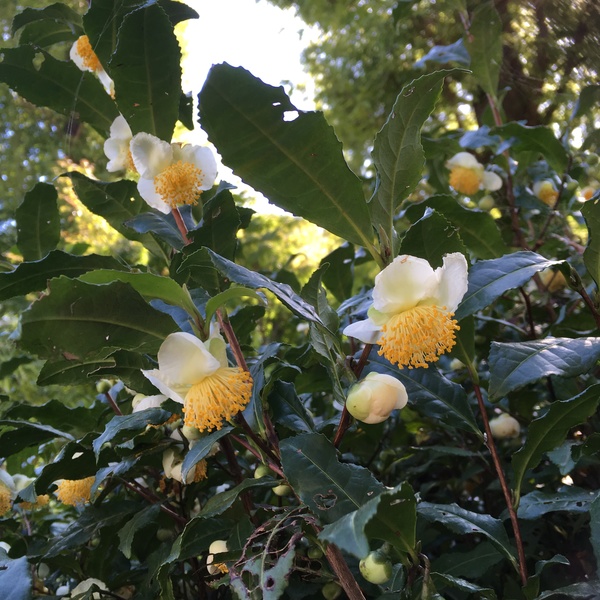
Camellia sinensis (tea, "Chanoki")
Japanese name: チャノキ (茶木)
Scientific name: Camellia sinensis
[Overview]
An evergreen shrub or small tree 1–2 m tall.
Young branches are green.
Leaves are simple and alternate, elliptic, 5–9 cm long and 2–4 cm wide.
They are thick, dark green and glossy on the upper surface.
The leaf margins have blunt or wavy serrations.
The midrib and lateral veins are markedly sunken on the upper side and raised on the underside.
The underside of the leaf at first has long appressed hairs, but later becomes hairless.
The petiole is 3–7 mm long.
The flowers grow singly in the leaf axils at the branch tips or in the axil of the lowest scale leaf of the leaf bud below.
The flowers face downward, are white and 2–3 cm across, with 5–7 round petals that are notched at the tip.
The flower stalk is 1.2–1.4 cm long and bends downward like a hook.
There are many stamens.
The fruit is a spherical capsule 1 cm across, with a thick pericarp containing brown seeds.
The fruit splits open when ripe.
[History]
It was first introduced as a medicinal plant, and from the Kamakura period it was widely used as a drink, giving rise to cultures such as the tea ceremony.
[Cultivation]
Propagate from seed or by cuttings.
The germination rate of seeds drops extremely if they are dried, so sow them immediately after harvest or store them without letting them dry.
It grows in sun to partial shade, but it is best to avoid places exposed to afternoon sun and places in overly dark shade.
The suitable growing area is south of the southern Tohoku region; it is vulnerable to cold, and may die if exposed to low temperatures or frost.
Avoid the north wind in winter as well.
It prefers well-drained, deep soil.
The roots extend deep, so for plants in the ground, transplanting after they have taken root is difficult.
Water thoroughly when the soil surface dries.
For plants in the garden, once they have taken root no watering is particularly needed unless it becomes severely dry.
Apply slow-release fertilizer in early spring.
It has strong sprouting ability and is clipped to make hedges and the like, but flower buds form in early summer to summer, so if pruning, April, before the new shoots emerge, is best.
Pests and diseases include white root rot, tea tussock moth (Chadokuga) and scale insects.
In particular, the tea tussock moth can cause a skin rash just from touching it, so caution is needed.
Details
Japanese: チャノキ(茶木)、チャ(茶)
Translated from our Japanese encyclopedia. If anything differs, the Japanese page is correct.