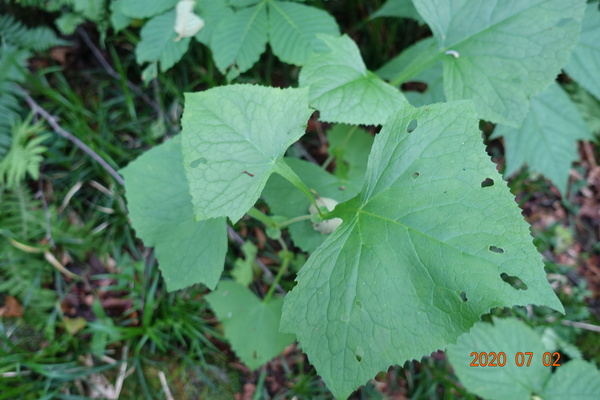
Japanese name: イヌドウナ(犬唐菜) Scientific name:Parasenecio tanakae
[Overview]
A perennial 1–2 m tall, found in slightly moist places inside and at the edges of deciduous forests.
It has a short rhizome.
The stem is thick and hollow.
There are basal leaves and stem leaves; the basal leaves have withered by the flowering period.
The stem leaves are simple and alternate; those in the middle of the stem are triangular-reniform, up to 20 cm long and 35 cm wide, with a sharply pointed tip and irregular serrations along the margin.
The petiole has broad wings, and its base spreads out widely like ears and clasps the stem; the leaf sheath does not close into a cylinder.
White flower heads are borne in a panicle at the stem tip.
Each flower head consists of 8–9 florets; the involucre is narrowly cylindrical, 0.7–0.8 cm long, with 6–8 involucral bracts.
The fruit is an achene with a white pappus.
[Uses]
The spring shoots are eaten as a wild vegetable (sansai).
[Cultivation]
Propagate from seed, by division, or by cuttings.
It prefers slightly moist places in partial shade with good drainage and good water retention.