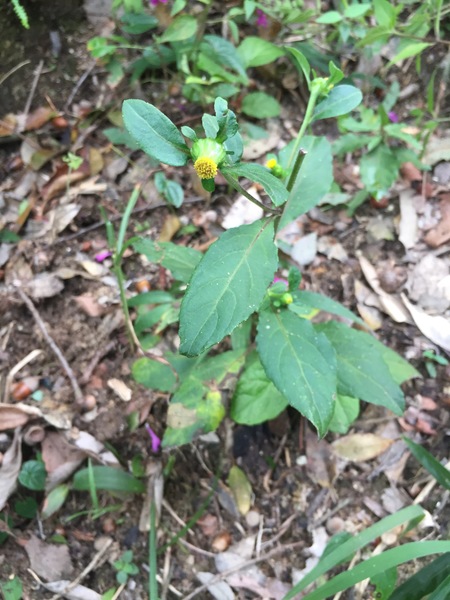
Japanese name: ガンクビソウ(雁首草) Scientific name:Carpesium divaricatum
[Overview]
A perennial 25–100 cm tall, found in partial shade in mountain forests and at forest edges.
The stem is erect and branches in the upper part, with the branches spreading and ascending.
The stem bears short soft hairs, as do the leaves.
There are basal leaves and leaves alternate on the stem; the basal leaves have withered by flowering time.
The stem leaves are simple; the lower ones, including the petiole, are 7–23 cm long and 3–10 cm wide, ovate to oblong, with low, slightly wavy teeth and glandular dots on the underside.
The petiole is winged only in its upper part.
The leaves on the upper part of the stem are narrowly oblong to oblong-lanceolate and stalkless.
The flower heads consist only of yellow tubular flowers; usually one is borne at the tip of a branch, with 2–4 recurved, oblong-oblanceolate bracts.
The involucre is ovoid with a slightly narrowed tip; the involucral bracts overlap like roof tiles in 4 divisions, and the outer ones are short.
Rarely, long-stalked inflorescences appear on the lower branches.
The fruit is an achene with a short beak at the tip.
Sticky fluid comes out of the beak.
[Notes]
The Japanese name compares the flower to the bowl of a kiseru (Japanese pipe).