
Plant Encyclopedia

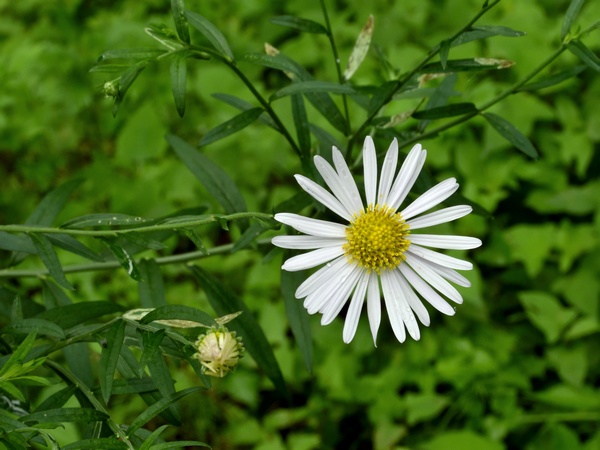
Aster iinumae ("Yugagiku")
Japanese name: ユウガギク (柚香菊)
Scientific name: Aster iinumae
[Overview]
A perennial 40–100 cm tall, found in moist places in hills and fields.
It has long creeping underground stems.
The stem branches well.
There are basal leaves and stem leaves.
The stem leaves are alternate, oblong to lanceolate, 7–8 cm long and 3–4 cm wide, pinnately cut, with short hairs on both surfaces.
Flower heads 2.5–3.5 cm across are borne at the branch tips, with white to pale purple ray florets and yellow tubular florets.
The involucral bracts are in 3 rows and sparsely covered with short hairs.
The achene is obovate, 3 mm long, with glandular hairs and bristles, and the pappus is very short, 0.3 mm long.
[Uses]
The young leaves are used as a wild vegetable.
[Cultivation]
Propagate from seed, by division, or by shoot cuttings.
It prefers sunny, well-drained soil that is moderately moist.
It is vigorous and, if the environment suits it, grows well even when left alone.
Rainfall is sufficient for watering.
If a base fertilizer is applied, no further fertilizer is particularly needed.
If you do not intend to collect seed, remove spent flowers promptly after flowering.
Pests and diseases include powdery mildew, slugs, cutworms and aphids.
[Notes]
One theory holds that the name comes from its yuzu-like fragrance.
Details
Translated from our Japanese encyclopedia. If anything differs, the Japanese page is correct.