
Plant Encyclopedia

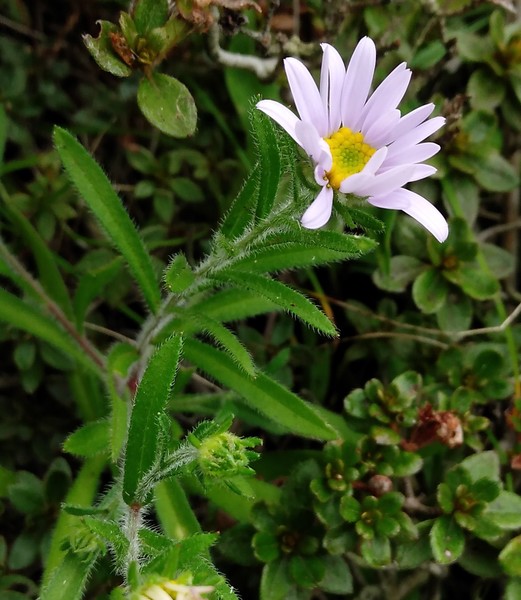
Aster hispidus var. hispidus ("Yamajinogiku")
Japanese name: ヤマジノギク (山路野菊)
Scientific name: Aster hispidus var. hispidus
[Overview]
A biennial found in sunny, dry grasslands and gravelly ground, growing 0.3–1 m tall.
The stem branches and is hairy.
There are basal leaves and stem leaves; the basal leaves are oblanceolate, 7–13 cm long and 1–1.5 cm wide, with sparse hairs on both surfaces, and the bases gradually narrow into a winged petiole; they have withered by flowering time.
The stem leaves are simple and alternate, lanceolate to linear, 5–7 cm long and 0.4–2 cm wide, with bases that gradually narrow.
Flower heads are borne at the branch tips, forming a conical to corymbose flower cluster overall.
The flower heads are 4 cm across, with pale purple ray florets and yellow tubular florets.
The involucre is saucer-shaped, and the involucral bracts are in 2 rows.
The achene is a flattened obovate, 2.5–3 mm long; the pappus of the tubular florets is about 4 mm long and tinged reddish brown, while that of the ray florets is around 1 mm long and white.
[Cultivation]
Propagate from seed, by division, or by stem cuttings.
It prefers sunny, well-drained soil.
It is vigorous and, if the environment suits it, grows well even when left alone.
For potted plants, water thoroughly when the soil surface dries; for plants in the ground, rainfall is sufficient unless sunny weather continues in summer and the soil dries out.
If base fertilizer is applied, little further fertilizer is needed, but for potted plants a small amount of oil cake may be given in spring.
If you do not intend to collect seed, remove spent flowers promptly after flowering.
Pests and diseases include powdery mildew, slugs, cutworms and aphids.
Details
Translated from our Japanese encyclopedia. If anything differs, the Japanese page is correct.