
Plant Encyclopedia

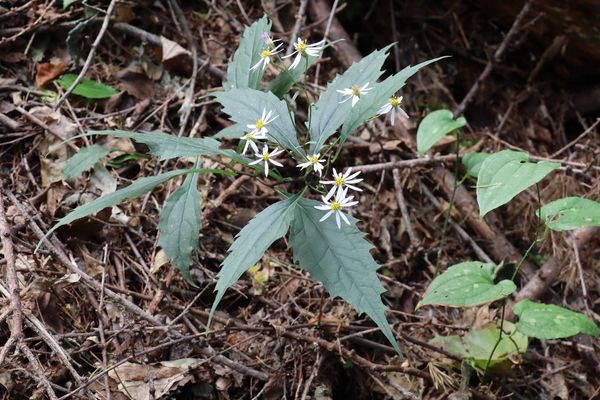
Aster ageratoides var. ageratoides ("Shiroyomena")
Japanese name: シロヨメナ (白嫁菜)
Scientific name: Aster ageratoides var. ageratoides
[Overview]
A perennial 30–150 cm tall, found at forest edges in the mountains and similar places.
It has long creeping underground stems.
The stem branches in the upper part.
There are both basal leaves and stem leaves.
The stem leaves are simple and alternate, oblong-lanceolate, 4.5–15 cm long and 2–6 cm wide, with three conspicuous veins.
The leaf margins have large teeth.
The leaf base narrows and runs into a very short petiole.
The upper leaves have almost no petiole.
Flower heads are borne in corymbs at the top of the stem.
The flower heads are about 1.5–2 cm across, and the ray florets are white, sometimes tinged with pale purple.
The involucre is 4 mm long, and the involucral bracts are in 3 rows.
The achene is narrowly obovate, 2.5 mm long, and the pappus is 4 mm long.
[Cultivation]
Propagate from seed, by division, or by stem cuttings.
It prefers a well-drained place in partial shade, out of the afternoon sun.
When planted in the ground, it is best planted under deciduous trees.
For potted plants, water thoroughly when the soil surface dries; for plants in the ground, rainfall is sufficient unless summer brings a long spell of sunny weather and the soil dries out.
If fertilizer is applied at planting time, little more is needed, but for potted plants a small amount of oil cake may be given in spring.
If you do not intend to collect seed, promptly remove spent flowers once flowering is over.
Pests and diseases include powdery mildew, slugs, cutworms and aphids.
Details
Translated from our Japanese encyclopedia. If anything differs, the Japanese page is correct.