
Plant Encyclopedia

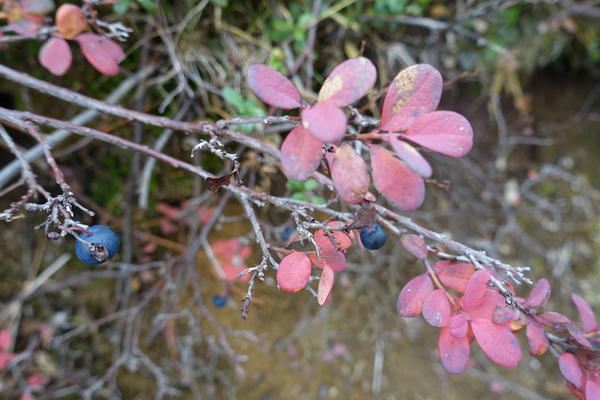
Vaccinium uliginosum (bog bilberry, "Kuromamenoki")
Japanese name: クロマメノキ (黒豆木)
Scientific name: Vaccinium uliginosum
[Overview]
A deciduous shrub found on rocky, gravelly ground and in wetlands from the subalpine to the alpine zone; its form varies with growing conditions, from less than 10 cm to 80 cm tall.
It often forms large colonies.
Young branches are slightly ridged.
Leaves are simple and alternate, obovate to elliptic, 1–3.5 cm long and 0.3–2 cm wide, of thick papery texture, hairless on both sides, with a somewhat conspicuous net-like pattern of veins.
The leaf margins are entire.
1–3 flowers hang downward from the leaf axils, so that the flowers form a raceme along the whole of the new branch.
The corolla is pale reddish yellow-green and urn-shaped, about 0.5 cm long, with 5 shallow lobes at the tip.
The tips of the lobes curl back.
There are 10 stamens.
The fruit is a spherical berry about 1 cm across, ripening to a blackish purple covered with a whitish bloom; it is sweet and edible.
[Cultivation]
Propagate from seed or by cuttings.
For seed, wash fully ripe fruit to remove the pulp and sow immediately, or bury the seeds in moist vermiculite or similar so they do not dry out and store them in a cool, dark place; take them out the following spring and wash them thoroughly once more before sowing.
It suits cool regions and prefers a sunny, well-ventilated place without afternoon sun, and well-drained acidic soil.
Water thoroughly when the soil surface dries, take care that it does not become hot and humid, and in summer water in the evening or later when the temperature drops.
Apply organic fertilizer in spring and autumn, so that no fertilizer remains in midsummer.
There are no particular pests or diseases.
Details
Japanese: クロマメノキ(黒豆木)、アサマブドウ(浅間葡萄)
Translated from our Japanese encyclopedia. If anything differs, the Japanese page is correct.