
Plant Encyclopedia

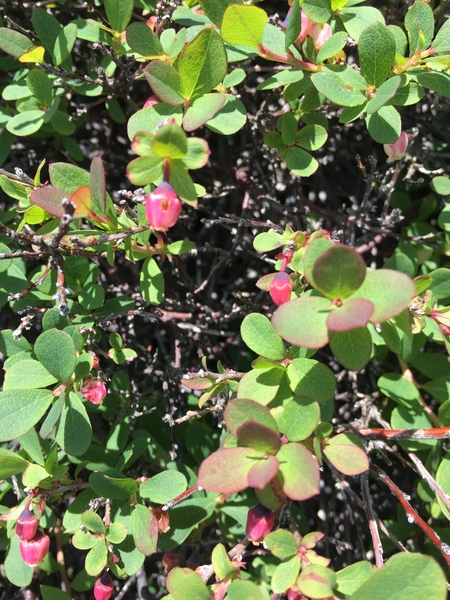
Vaccinium ovalifolium var. ovalifolium (Alaska blueberry, "Kurosugo")
Japanese name: クロウスゴ (黒臼子)
Scientific name: Vaccinium ovalifolium var. ovalifolium
[Overview]
A deciduous shrub 0.5–1.2 m tall, common in heavy-snow areas on the Sea of Japan side, found at the edges of subalpine coniferous forests and in shrub woodland of the alpine zone.
Young branches are green, often tinged with red, conspicuously ridged, and hairless.
The leaves are simple and alternate, ovate to elliptic, 1–5 cm long and 1–3 cm wide, and hairless on both surfaces.
The leaf margin is entire, although small serrations sometimes appear at the base.
There is a very short petiole.
The flowers are borne singly in the leaf axils, facing downward; they are urn-shaped, 0.5 cm long, shallowly 5-lobed, and greenish white, often tinged with reddish brown.
There are 10 stamens.
The fruit is spherical, about 1 cm in diameter, with the tip depressed in a pentagonal shape; it ripens blackish purple with a whitish bloom and is edible.
[Cultivation]
Propagate from seed or cuttings.
For seed, wash fully ripe fruit to remove the pulp and sow immediately, or bury the seeds in moistened vermiculite or similar so they do not dry out and store them in a cool, dark place; take them out the following spring and wash them thoroughly once more before sowing.
It prefers acidic soil that is sunny, airy and well drained.
For potted plants, water thoroughly when the soil surface dries, taking care to avoid hot and humid conditions, and in summer water after the evening, when the temperature drops.
For plants in the ground, rainfall is sufficient.
Apply organic fertilizer in spring and autumn, so that no fertilizer remains in midsummer.
There are no particular pests or diseases.
[Notes]
The Japanese name comes from the shape of the fruit.
Details
Japanese: クロウスゴ(黒臼子)、ミヤマクロウスゴ(深山黒臼子)、エゾクロウスゴ(蝦夷黒臼子)、ナガバクロウスゴ(長葉黒臼子)、ナガミクロウスゴ(長実黒臼子)
Translated from our Japanese encyclopedia. If anything differs, the Japanese page is correct.