
Plant Encyclopedia

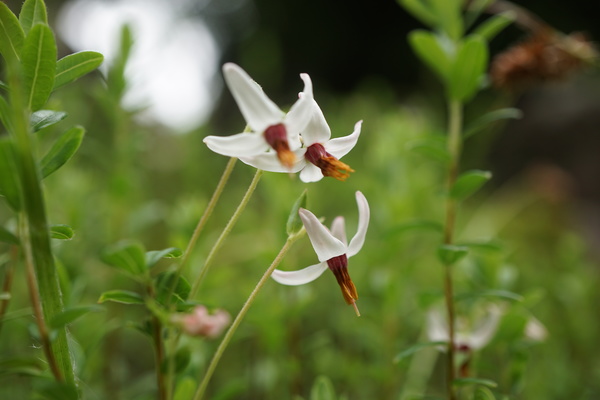
Vaccinium oxycoccos (swamp cranberry, "Tsurukokemomo")
Japanese name: ツルコケモモ (蔓苔桃)
Scientific name: Vaccinium oxycoccos
[Overview]
An evergreen small shrub found in bogs of cold regions and high elevations.
The thin stems creep through sphagnum moss and spread, producing roots from the nodes.
The leaves are simple and alternate, lanceolate to oblong, 0.5–1.5 cm long and 0.2–0.7 cm wide, with entire margins slightly rolled toward the underside, and the underside is slightly whitish.
The leaves turn yellow in autumn.
The flowers are borne in clusters of 1–4 at the tips of twigs, hanging downward at the ends of slender pedicels.
The pedicels are fairly densely covered with short hairs and have 2 small bracts in the middle.
The flowers are pale red; the corolla is deeply 4-lobed and curls back.
The stamens surround the style.
The fruit is spherical, 1 cm in diameter, and ripens red.
[Uses]
The fruit is eaten, and in North America it is also used as a folk medicine.
[Cultivation]
Propagate from seed, by division, or by shoot cuttings.
For seed, wash fully ripe fruit to remove the pulp and sow immediately, or bury the seeds in moistened vermiculite or similar so they do not dry out and store them in a cool, dark place; take them out the following spring and wash them thoroughly once more before sowing.
Cool regions are suitable; it is weak against heat and dryness and prefers acidic soil.
Use sphagnum moss alone, or sphagnum moss mixed with peat moss or kanuma soil, and grow it in partial shade.
Watch for dryness when watering, and water thoroughly when the surface of the planting medium dries.
It is best fertilized sparingly; apart from a base fertilizer, give liquid fertilizer in spring or autumn depending on how it is growing.
There are no particular pests or diseases.
Details
Japanese: ツルコケモモ(蔓苔桃)
Translated from our Japanese encyclopedia. If anything differs, the Japanese page is correct.