EVERGREEN

Plant Encyclopedia

Enkianthus perulatus

Enkianthus perulatus (dodan-tsutsuji)

Japanese name: ドウダンツツジ (燈台躑躅)
Scientific name: Enkianthus perulatus

Enkianthus perulatus

[Overview]
A deciduous shrub 1–2 m tall, found on rocky sites in low mountains and on sunny, infertile ground.
It branches freely in the upper part and forms a rounded crown.
The leaves are alternate, clustered at the branch tips, narrowly obovate, 2–3 cm long and 0.8–1.5 cm wide, with fine hooked serrations.
They turn a vivid red in autumn and have great ornamental value.
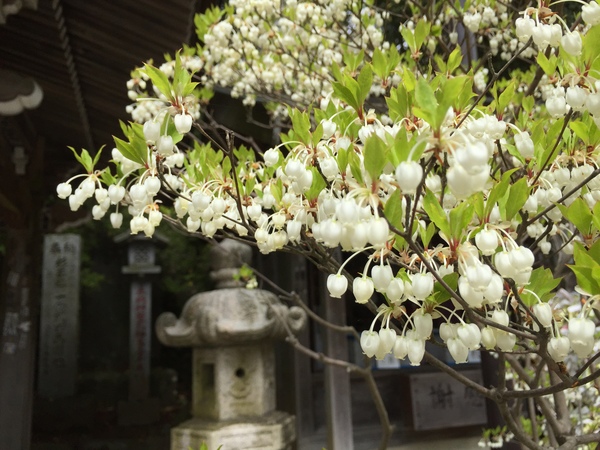
The flowers open at the same time as the leaves, borne 1–5 in umbel-like clusters at the branch tips and opening downward.
The corolla is white and urn-shaped, about 5 mm across; the tip is shallowly 5-lobed with short, curled-back lobes, and the base of the corolla swells to cover the sepals.
The fruit is a capsule borne upright.

[Uses]
It tolerates shearing and is widely used as a garden tree and for hedges.

[Cultivation]
Propagate by cuttings.
It prefers a sunny site.

[Notes]
The name is said to compare the way the branches fork to the knotted lamp stands once used in the imperial court.

Details

Names
English: dodan-tsutsuji, white enkianthus
Japanese: ドウダンツツジ(燈台躑躅)、ドウダン(燈台)、マンテンセイ(満天星)
Life form
Shrub
Evergreen / deciduous
Deciduous
Leaf type
Broadleaf
Habit
Terrestrial
Planting (or sowing) season
February, March, October, November, December
Flowering season
April, May
Fruiting season
October
Distribution or origin
Japan (Honshu: Chiba, Shizuoka, Aichi, Kii Peninsula; Kochi, Kagoshima), Taiwan
Growth form
Branching
Height
1000–2000 mm
Leaf shape
Simple leaf (unlobed)
Leaf arrangement
Alternate
Leaf margin
Serrate
Inflorescence
Umbel
Flower color
White
Flower diameter
5
Fruit color
Brown
Leaf color
Green, Red
Availability of seeds and plants
Low
Form sold
Seedlings
Propagation
Cuttings
Sun exposure
Full sun
Water needs
Moderate
Soil needs
Required
Suitable uses
Bonsai, Potted plant, Hedge, Topiary, Cut flowers, Parks and gardens, Street trees
Pests
Scale insects, Aphids, Spider mites
Japan Flower Trade Code
27931

Translated from our Japanese encyclopedia. If anything differs, the Japanese page is correct.

Sponsored