
Plant Encyclopedia

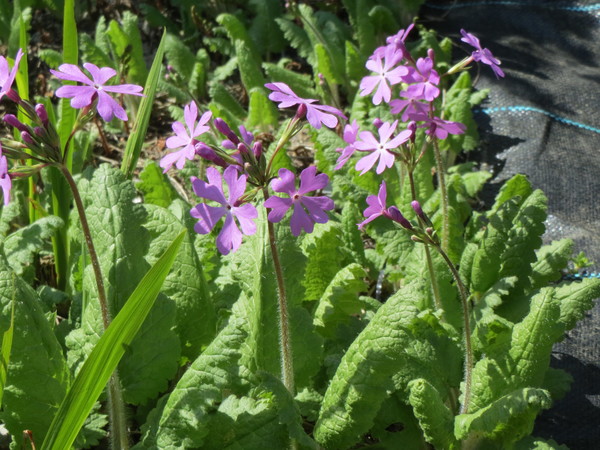
Primula sieboldii (Japanese primrose, "Sakuraso")
Japanese name: サクラソウ (桜草)
Scientific name: Primula sieboldii
[Overview]
A perennial 15–40 cm tall, found in sunny wetlands and open woodland.
It has a short, thick rhizome.
The whole plant is covered with long, white, crinkled hairs.
The leaves are simple and arise from the base, long ovate to ovate-oblong, 4–10 cm long and 3–6 cm wide.
The leaf surface is much wrinkled, and the margin has irregular, shallow, double teeth.
The petiole is 1–4 times as long as the leaf.
The leaves die back before summer, and the plant is dormant through the summer.
An umbel at the tip of a flower stalk 15–40 cm tall bears 5–20 reddish-purple flowers.
The corolla is 2–3 cm across and 5-lobed, with each lobe further notched into two at the tip.
The fruit is an oblate capsule 5 mm across.
[History]
In the middle Edo period (1716–1829), horticultural cultivation began in earnest, centered on the samurai class, and in the late Edo period (1830–67) the number of cultivars increased greatly.
More than half of the roughly 300 cultivars existing today were handed down from the Edo period.
[Uses]
The roots were used as a folk medicine, as an expectorant.
[Cultivation]
Propagate from seed, by division, or by root cuttings.
It prefers soil that is well drained and retains water well.
Keep it in full sun from sprouting until flowering; once the leaves begin to die back and during dormancy, place it in airy partial shade so that it is not weakened by heat and dryness.
Rain damages the flowers while they are open, so it is best to give rain protection.
During the growing season, water thoroughly when the soil surface begins to dry, and take care not to let it dry out during dormancy either.
Apply a slow-release fertilizer high in phosphorus and potassium as base fertilizer, and apply diluted liquid fertilizer once every 2 weeks to 1 month during flowering.
If you are not collecting seed, cut off the flower stalks after flowering so as not to tire the plant.
Pests and diseases include armyworms, slugs and nematodes.
[Notes]
The Japanese name compares the shape and color of the flower to those of the Sakura.
Details
Japanese: サクラソウ(桜草)、ニホンサクラソウ(日本桜草)
Translated from our Japanese encyclopedia. If anything differs, the Japanese page is correct.