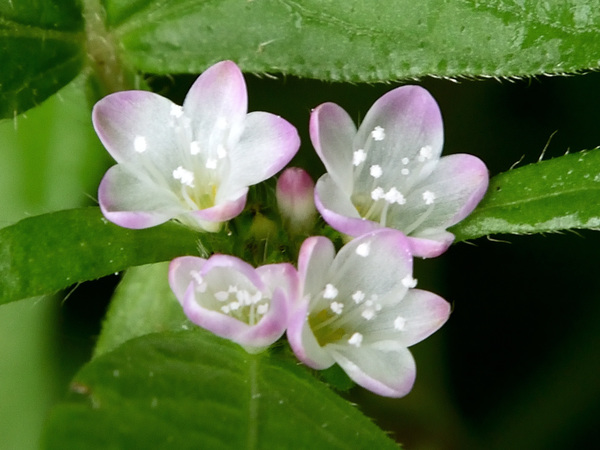
Japanese name: ミゾソバ(溝蕎麦) Scientific name:Persicaria thunbergii var. thunbergii
[Overview]
An annual 30–100 cm tall, found in wet places such as riversides and ditches, often growing in colonies.
The lower part of the stem creeps along the ground and spreads by rooting at the nodes, while the upper part is erect.
The stem has downward-pointing prickles.
Leaves are simple and alternate, halberd-shaped, 3–12 cm long and 2–10 cm wide, with stellate hairs and bristly hairs on both sides.
The leaf margin is also densely hairy.
The stipule sheath is a short tube, sometimes with a leaf-like margin.
A raceme shaped like a konpeito (a spiky sugar candy) arises at the stem tip.
There is no corolla; the calyx, 4–7 mm long and white in the lower part and reddish purple in the upper part, is conspicuous.
Cleistogamous flowers are borne at the tips of the creeping stems.
The fruit is a triangular-pyramidal achene 3–4 mm long.
[Notes]
The Japanese name means a plant resembling buckwheat that grows in ditches.
The alternative name Ushi-no-hitai comes from the shape of the leaf seen from the front, which resembles an ox's forehead.