EVERGREEN

Plant Encyclopedia

Persicaria orientalis

Persicaria orientalis (princess-feather, "Oketade")

Japanese name: オオケタデ (大毛蓼)
Scientific name: Persicaria orientalis

Persicaria orientalis

[Overview]
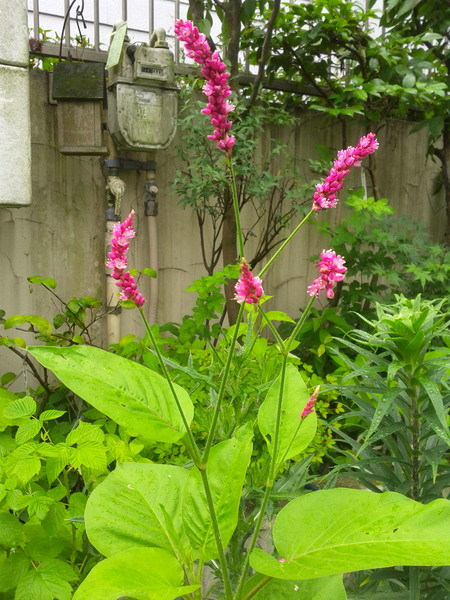
An annual 1–2.2 m tall, found in sunny vacant lots and similar places.
The whole plant is hairy.
The stem is erect and branched.
The leaves are simple and alternate, ovate, 10–30 cm long and 6–20 cm wide.
Pseudoracemes 2–8 cm long emerge, bearing densely packed flowers.
The flowers have no corolla; the conspicuous calyx is pale red, sometimes white.
The fruit is an achene, glossy black.

[History]
It was introduced as a medicinal herb in the Edo period, and plants later cultivated for ornament escaped and have become naturalized.

[Uses]
The seeds and leaves are used medicinally.

[Cultivation]
Propagate from seed.
It also spreads readily from self-sown seed.
In a sunny place it grows well regardless of soil type.

Details

Names
English: princess-feather, kiss-me-over-the-garden-gate
Japanese: オオケタデ(大毛蓼)、オオベニタデ(大紅蓼)、ベニバナオオケタデ(紅花大毛蓼)
Life form
Annual
Habit
Terrestrial
Planting (or sowing) season
April, May, September, October
Flowering season
August, September, October, November
Distribution or origin
Central-southern China, Taiwan, Southeast Asia, India
Height
1000–2200 mm
Leaf shape
Simple leaf (unlobed)
Leaf arrangement
Alternate
Leaf margin
Entire
Inflorescence
Raceme
Flower color
Pink, White
Inflorescence length
20–80
Leaf color
Green
Availability of seeds and plants
Low
Form sold
Seedlings
Propagation
Seed
Sun exposure
Full sun
Water needs
Moderate
Soil needs
Required
Suitable uses
Cut flowers, Parks and gardens
Uses
Medicinal
Japan Flower Trade Code
50906

Translated from our Japanese encyclopedia. If anything differs, the Japanese page is correct.

Sponsored