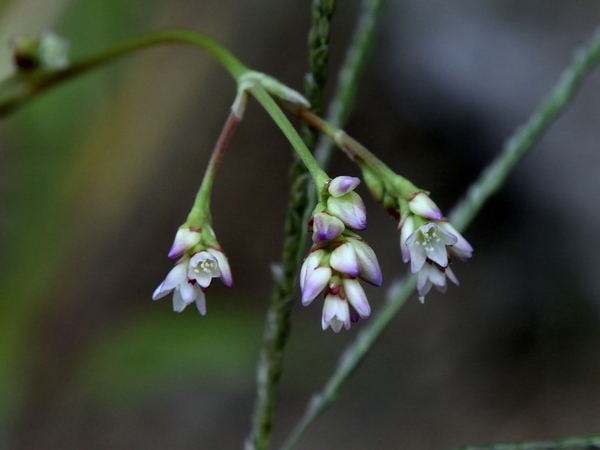
Japanese name: ヤノネグサ(矢の根草) Scientific name:Persicaria muricata
[Overview]
An annual 20–70 cm tall, seen on paddy banks, at the waterside and in wetlands.
The stem is ridged, creeping along the ground in the lower part and rising in the upper part.
Small downward-pointing prickles grow on the ridges of the upper stem, but the presence of prickles varies.
Leaves are simple and alternate, arrowhead-shaped, 2–8 cm long and 1–4 cm wide.
The ocrea is tubular, with the tip cut off horizontally.
Short pseudoracemes at the stem tips and leaf axils bear flowers densely.
The stalk of the inflorescence usually has short hairs and glandular hairs.
The flowers have no corolla; the conspicuous calyx is white to red.
The fruit is a 3-angled achene, glossy brown.