
Plant Encyclopedia

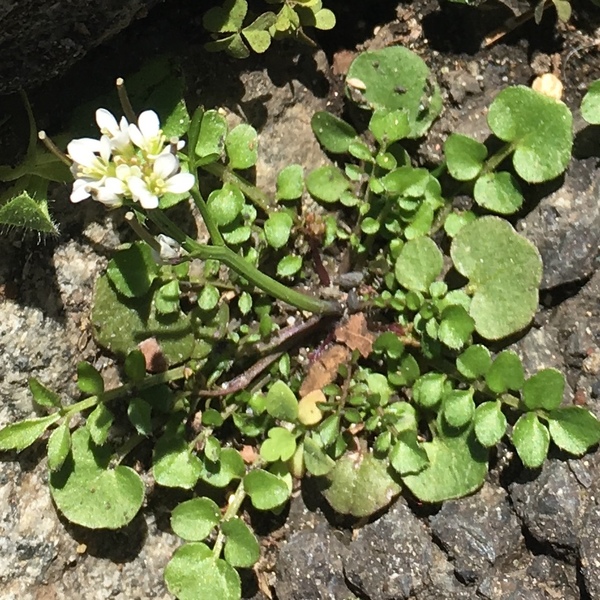
Cardamine hirsuta (hairy bittercress, "Michitanetsukebana")
Japanese name: ミチタネツケバナ (道種漬花、道種浸花)
Scientific name: Cardamine hirsuta
[Overview]
A winter annual that grows in clusters along roadsides, in lawns and similar places.
The stem is 3–30 cm tall and hairless.
The basal leaves form a rosette and are pinnately divided to the midrib, with 3–5 pairs of lateral lobes.
Each lobe is broadly elliptic to ovate, and the terminal lobe is the largest.
The basal leaves remain without withering even at fruiting time.
Few leaves are borne on the stem, about 0–2, and their lobes are narrower than those of the basal leaves.
The flowers are borne in racemes and are white and 4-petaled.
The petals are elliptic, 2–3 mm long.
There are 4 stamens.
The fruit is a silique 1–2 cm long and erect.
Inside the fruit, many seeds about 1 mm long are arranged in one row.
[History]
It is estimated to have been naturalized by the 1970s; it was collected in Toyama in 1988, and in 1992 its naturalization was reported from existing specimens and a Japanese name was given.
[Notes]
It closely resembles Tanetsukebana, but can be distinguished by its hairless stem, the stalked leaflets of its basal leaves, the few leaves on its stem, the many flowers with petals 2–3 mm long and 4 stamens, and the basal leaves that remain at fruiting time.
Details
Japanese: ミチタネツケバナ(道種漬花、道種浸花)、ケタネツケバナ(毛種漬花、毛種浸花)
Translated from our Japanese encyclopedia. If anything differs, the Japanese page is correct.