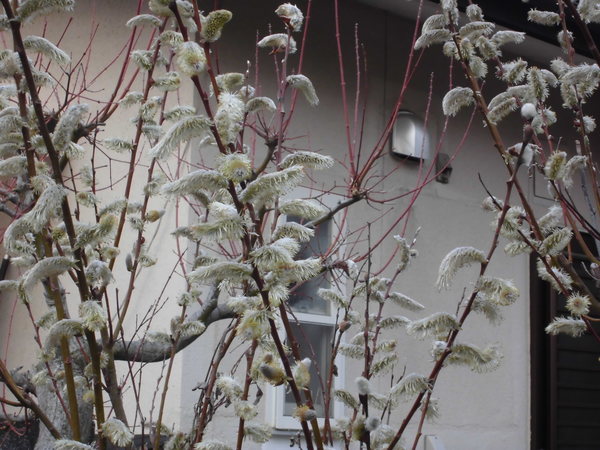
Japanese name: フリソデヤナギ(振袖柳) Scientific name:Salix ×leucopithecia
[Overview]
A deciduous shrub up to 3 m tall, regarded as a hybrid of Bakko-yanagi and Neko-yanagi.
Leaves are simple and alternate, oblong-elliptic, 10–15 cm long and 3–4.5 cm wide, rather thick in texture, with fine serrations on the margin.
The underside of the leaf is powdery white and covered with cottony hairs.
It is dioecious.
The flowers are densely borne on oblong catkins that appear before the leaves unfold, and have bracts densely covered with long white hairs.
The flowers have no petals.
The red bud scales enclosing the large flower buds are conspicuous and are the origin of its alternative name.
[Cultivation]
Propagate by cuttings.
It prefers sunny, well-drained, moist soil.
It dislikes dry places.
For potted plants, water thoroughly when the soil surface begins to dry.
In winter, applying organic fertilizer alone is sufficient.
Pests and diseases include powdery mildew, rust, longhorn beetles and aphids.