
Plant Encyclopedia

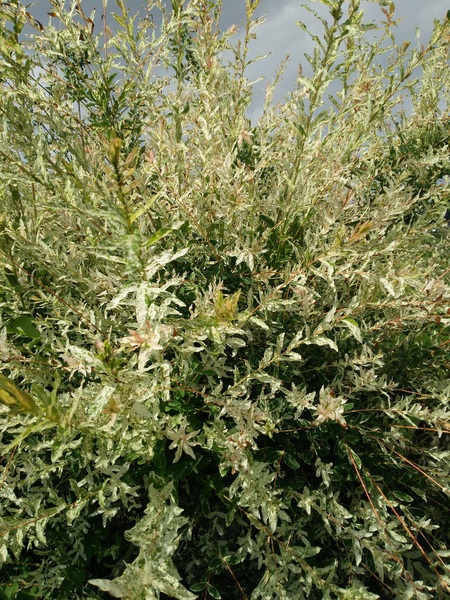
Salix integra ("Inukoriyanagi")
Japanese name: イヌコリヤナギ (犬行李柳)
Scientific name: Salix integra
[Overview]
A deciduous shrub about 2–3 m tall, found in wet or moist places.
It is dioecious.
Leaves are simple, alternate or opposite, oblong-elliptic, 4–8 cm long and 1.5–2 cm wide, with low, fine serrations.
Most leaves are stalkless; when a petiole is present it is 5 mm long, and there are no stipules.
The flowers are densely borne on cylindrical catkins that appear before the leaves unfold, with 3–4 leaves at the base.
Male catkins are 2–3.5 cm long and 0.6–1 cm across, and the anthers of the stamens are deep red.
Female catkins are 1.5–2.5 cm long and 0.4–0.5 cm across, densely covered with short white hairs.
The flowers have no petals.
The fruit is a capsule that splits open when ripe, releasing seeds wrapped in cottony hairs called ryujo (willow cotton).
[Cultivation]
Propagate by cuttings.
It prefers sunny, well-drained, moist soil.
It dislikes dry places.
In winter, apply organic fertilizer around the plant.
Pests and diseases include powdery mildew, rust, longhorn beetles and aphids.
Details
Translated from our Japanese encyclopedia. If anything differs, the Japanese page is correct.