
Plant Encyclopedia

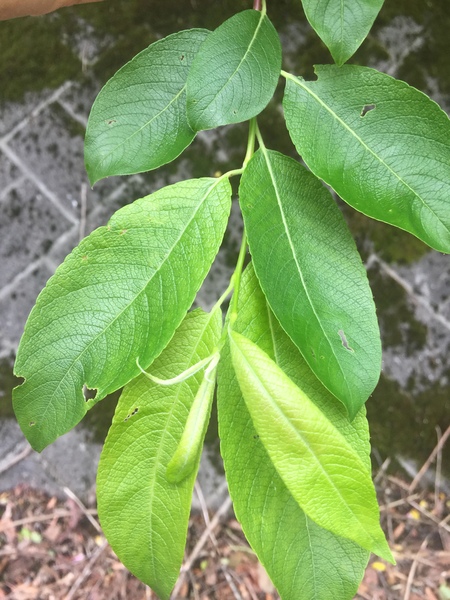
Salix caprea (goat willow, "Bakkoyanagi")
Japanese name: バッコヤナギ (跋扈柳)
Scientific name: Salix caprea
[Overview]
A deciduous tree 15 m tall, found in hills and mountain areas.
The bark is blackish gray, and the surface of the wood usually has raised ridges.
The leaves are simple and alternate, elliptic, 5–17 cm long and 3–7 cm wide.
The upper surface has conspicuous wrinkles sunken along the veins, and the underside is covered with curly white hairs that give it a powdery white tinge.
The leaf margins usually have low, wavy teeth.
The petiole is 1–2.5 cm long.
The margins of new leaves, except at the tip, roll toward the underside.
The plant is dioecious.
The flower buds (winter buds) are large and reddish brown.
The flowers are densely arranged on elliptic spikes that appear before the leaves unfold; the male spikes are 3–5 cm long and the female spikes 2–4 cm long.
The flowers have no petals.
The fruit is a capsule that splits open when ripe, releasing seeds wrapped in cottony hairs called ryujo.
[Uses]
The bark and leaves are used medicinally.
The wood was used for cutting boards, ship timber and other purposes.
Details
Japanese: バッコヤナギ(跋扈柳)、ヤマネコヤナギ(山猫柳)、マルバノバッコヤナギ(丸葉跋扈柳)、エゾノバッコヤナギ(蝦夷跋扈柳)、コウライバッコヤナギ(高麗跋扈柳)、マンシュウバッコヤナギ(満州跋扈柳、ナガバノバッコヤナギ(長葉跋扈柳))
Translated from our Japanese encyclopedia. If anything differs, the Japanese page is correct.