
Plant Encyclopedia

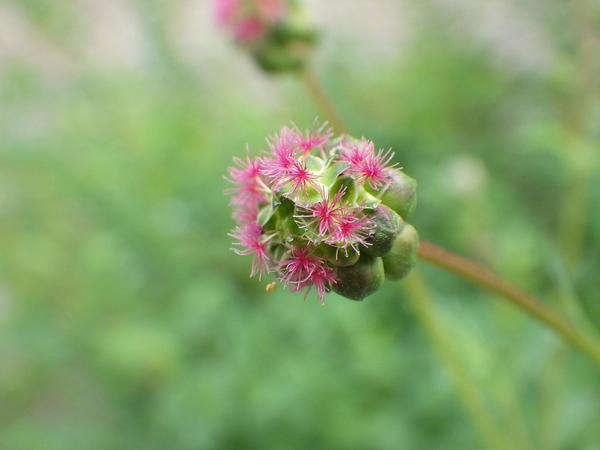
Sanguisorba minor (salad burnet, "Orandawaremoko")
Japanese name: オランダワレモコウ
Scientific name: Sanguisorba minor
[Overview]
A perennial 30–90 cm tall.
In its native range it grows in pastures and similar places, and is often found on limestone soil.
The stem is hairless but sometimes hairy.
The leaves are of two kinds, basal leaves and leaves alternate on the stem, both odd-pinnately compound with 5–13 leaflets.
The leaflets are elliptical, about 2.5 cm long, with coarse teeth on the margin.
At the branch tips it bears ovoid to spherical spikes 1.5–2.5 cm long; the lower part of the spike has male or bisexual flowers, the middle part bisexual flowers, and the upper part female flowers.
The flowers have no petals; the stigmas and stamens are reddish purple, and both protrude.
The calyx is green.
The fruit is an achene.
[Uses]
The young leaves are used in salads and similar dishes.
[Cultivation]
Propagate from seed or by division.
It prefers a sunny, well-drained, well-ventilated place.
It dislikes acidic soil.
For potted plants, water thoroughly when the soil surface dries; for plants in the ground, rainfall is sufficient unless summer brings a long sunny spell and the soil becomes severely dry.
In spring, apply a small amount of slow-release fertilizer.
When using it in salads, the leaves become tough once the flowers bloom, so cut off the flower stalks as soon as they begin to elongate.
Picking the old leaves also encourages young leaves to emerge.
There are no particular pests or diseases.
Details
Japanese: オランダワレモコウ、サラダバーネット、バーネット
Translated from our Japanese encyclopedia. If anything differs, the Japanese page is correct.