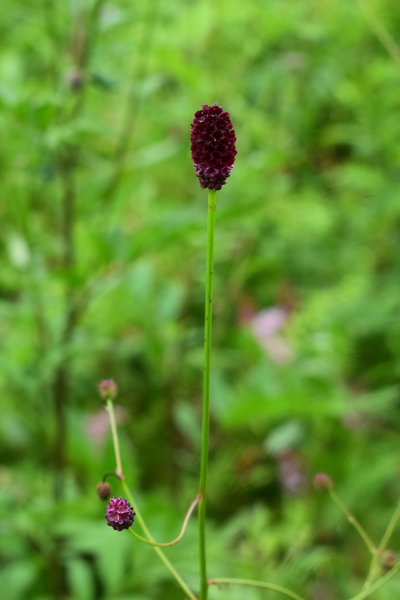
Japanese name: ワレモコウ(吾木香、吾亦紅) Scientific name:Sanguisorba officinalis
[Overview]
A perennial 30–100 cm tall, found in sunny mountain grasslands and similar places.
The stem is thin and hard, and branches in the upper part.
The leaves are of two kinds, basal leaves and leaves alternate on the stem, both odd-pinnately compound with 5–13 leaflets.
The leaflets are elliptical, with coarse teeth on the margin.
At the branch tips it holds upright ovoid to cylindrical spikes 1–2.5 cm long and 0.5–1 cm in diameter, densely covered with small flowers that open from the top of the spike downward.
The flowers have no petals; the calyx and the 4 stamens are dark reddish purple.
The fruit is an achene.
[Uses]
The rhizome is called chiyu and is used as a crude drug.
[Cultivation]
Propagate from seed or by division.
It prefers a sunny, well-drained, well-ventilated, fertile and slightly moist soil.
Avoid dry places and places where water stagnates.
For potted plants, water thoroughly when the soil surface dries; for plants in the ground, rainfall is sufficient unless summer brings a long sunny spell and the soil becomes severely dry.
In spring, apply a small amount of slow-release fertilizer.
There are no particular pests or diseases.