EVERGREEN

Plant Encyclopedia

Rubus trifidus

Rubus trifidus ("Kajiichigo")

Japanese name: カジイチゴ (梶苺)
Scientific name: Rubus trifidus

Rubus trifidus

[Overview]
A deciduous shrub up to 2 m tall, found at forest edges near the coast.
The stem branches well, and young branches have glandular hairs and soft hairs but no prickles.
Leaves are alternate, ovate-round, palmately divided into 5–7 lobes.
The upper surface of the leaf is glossy.
The leaf margin has double teeth.
The leaf stalk has no prickles.
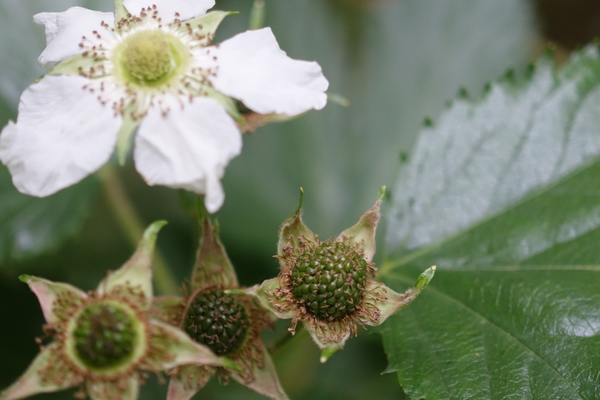
Several white 5-petaled flowers 2.5–3 cm across grow facing upward in cymes at the stem tips.
The fruit is a spherical aggregate fruit about 1 cm across, ripening orange to yellow; it is sweet and edible.

[Uses]
The fruit is edible and is also used medicinally.
The root bark is used medicinally.

[Cultivation]
Propagate by division or cuttings.
It prefers sunny, well-drained soil.
It is easy to grow.
Rainfall is sufficient for watering.
Applying organic fertilizer in winter stabilizes fruit set.
There are no particular pests or diseases.

[Notes]
The Japanese name comes from the leaves resembling those of the Kajinoki (paper mulberry).

Details

Names
Japanese: カジイチゴ(梶苺)
Life form
Shrub
Evergreen / deciduous
Deciduous
Leaf type
Broadleaf
Habit
Terrestrial
Similar plants
Planting (or sowing) season
December, January, February, March
Flowering season
April, May
Fruiting season
May, June
Distribution or origin
Japan (Honshu: Fukaura, Aomori and south, Shikoku, Kyushu), Korea
Height
2000 mm
Leaf shape
Lobed leaf
Leaf arrangement
Alternate
Leaf margin
Doubly serrate
Inflorescence
Cyme
Number of petals
5
Flower color
White
Flower diameter
25–30
Fruit color
Orange, Yellow
Leaf color
Green
Availability of seeds and plants
Low
Form sold
Seedlings
Propagation
Cuttings, Division
Sun exposure
Full sun
Water needs
Moderate
Soil needs
Required
Tolerance
Cold tolerance, Heat tolerance, Salt-spray tolerance
Suitable uses
Cut flowers, Parks and gardens
Edible parts
Fruit
Uses
Medicinal, Edible
Japan Flower Trade Code
1707

Translated from our Japanese encyclopedia. If anything differs, the Japanese page is correct.

Sponsored