
Plant Encyclopedia

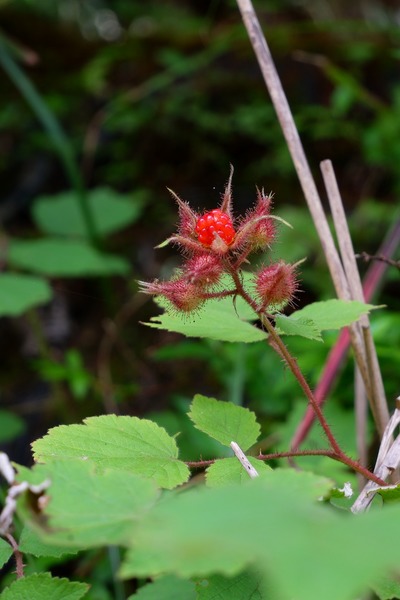
Rubus phoenicolasius ("Ebigaraichigo")
Japanese name: エビガライチゴ (海老殻苺)
Scientific name: Rubus phoenicolasius
[Overview]
A deciduous shrub 0.5–2 m tall, found at the edges of woods and in thickets in hills to mountains.
The stems extend like vines, have sparse, somewhat flattened thorns, and are densely covered with reddish-brown bristles and long glandular hairs.
The leaves are alternate and trifoliate, but on the current year's branches odd-pinnate compound leaves with 5 leaflets are also mixed in.
The terminal leaflet is ovate-round, 5–8 cm in both length and width, with a sharply pointed tip and a notched double-serrate margin.
The underside of the leaf is densely covered with white hairs, and the veins and leaf axis have glandular hairs and thorns.
A raceme to panicle arising from the stem tip or leaf axils bears several 5-petaled flowers 1.5 cm across, in very pale pink to white.
The petals stand upright and do not open.
The calyx opens in a star shape, and its outer side, like the inflorescence, is densely covered with short hairs and long glandular hairs.
The fruit is a spherical aggregate fruit that ripens red and is edible.
[Uses]
The fruit is edible.
[Cultivation]
Propagate by cuttings.
It prefers sun to partial shade and fertile, well-drained, well-ventilated soil.
It is easy to grow.
For potted plants, water thoroughly when the soil surface dries; for plants in the ground, rainfall is sufficient.
Applying organic fertilizer in winter stabilizes fruit set.
There are no particular pests or diseases.
[Notes]
The Japanese name is said to compare the appearance of the calyx to a shrimp shell.
Details
Translated from our Japanese encyclopedia. If anything differs, the Japanese page is correct.